
NOYAFA NF-488
4.5Editor score
Supports standard and non-standard PoE
Includes RJ45 continuity testing
Backlit LCD for low light
This guide compares the top 10 Inline POE Testers for 2026 based on voltage accuracy, cable testing features, and compatibility with IEEE standards.
An Inline POE Tester is essential for network technicians who need to verify power delivery over Ethernet cables quickly. These tools ensure that switches and injectors provide the correct voltage and current to connected devices like cameras and phones.
We compared ten leading models based on their testing modes, display clarity, and ability to handle both standard and passive PoE systems. Each product was evaluated for portability, battery requirements, and support for the latest IEEE 802.3bt standards.
Each pick highlights key strengths and specific use cases to help you find the right tool for your network installation needs. Please note that prices and availability can change frequently, so check the latest details before purchasing.
4.5Editor score

4.1Editor score

4.1Editor score
The following table provides a side-by-side comparison of all ten Inline POE Testers, highlighting their key specifications and unique capabilities to help you make an informed decision.


The TRENDnet TC-NTP1 is a robust Inline POE Tester designed for professionals who require reliability and compliance in their network installations. It holds a strong reputation among technicians for its ability to handle high-wattage standards without needing external power sources. This makes it an ideal choice for field work where battery management is a hassle.
We may earn a commission when you buy through this link, at no additional cost to you.
Its standout feature is the NDAA compliance, which is critical for government and secure facility projects in the U.S. and Canada. The tester supports three distinct modes allowing you to check PSE devices, test non-standard passive PoE, and monitor inline voltage and amperage in real time. The step button allows you to lock specific readings like wattage for continuous monitoring during installation.
While the display is functional, it lacks the brightness of OLED screens found in newer models, which can be a drawback in very bright sunlight. Additionally, it is limited to gigabit ports, so it may not be the best choice for next-generation multi-gigabit network setups. However, for most standard PoE deployments, these trade-offs are acceptable given its durability and compliance features.
This tool is best suited for network engineers and government contractors who need a dependable, compliant testing solution. If you prioritize long-term reliability and the ability to test high-wattage devices without carrying extra batteries, the TC-NTP1 is an excellent investment.
Being NDAA compliant means you can use this tester in federal projects without worrying about prohibited equipment lists. This assurance is vital for large scale infrastructure contracts.
Supporting up to 100W allows you to test modern cameras and access points that require higher power budgets. This future-proofs your toolkit against new hardware requirements.
We may earn a commission when you buy through this link, at no additional cost to you.
The PoE-T100 stands out primarily for its bright OLED display, which provides exceptional clarity for reading voltage, current, and power data even in challenging lighting conditions. This tool is designed to be self-powered, drawing energy directly from the PoE or DC source, which eliminates the need for battery replacements during long field jobs.
We may earn a commission when you buy through this link, at no additional cost to you.
It supports three testing modes including PD mode, Inline mode, and DC mode, making it versatile for various network environments. The interface shows critical power data on a single page, allowing you to instantly identify PSE types and power levels without cycling through multiple screens. It is particularly useful for differentiating between standard and non-standard passive PoE setups.
As a newer product, it does not have the long track record of established brands like TRENDnet or Triplett, which might be a concern for enterprise procurement. The documentation could also be more detailed for advanced users looking to exploit its full DC testing capabilities. However, for general troubleshooting, the interface is intuitive.
This tester is perfect for IT professionals who value visibility and convenience. If you often work in dimly lit server rooms or require a device that reads DC voltage accurately alongside PoE, the OLED display and versatility of the PoE-T100 make it a premium choice.
The OLED screen ensures that even faint text is readable, reducing eye strain during long troubleshooting sessions. This is a significant upgrade over older LCD technology.
By drawing power from the line, the device is always ready when you need it. You never have to worry about dead batteries mid-installation.
We may earn a commission when you buy through this link, at no additional cost to you.
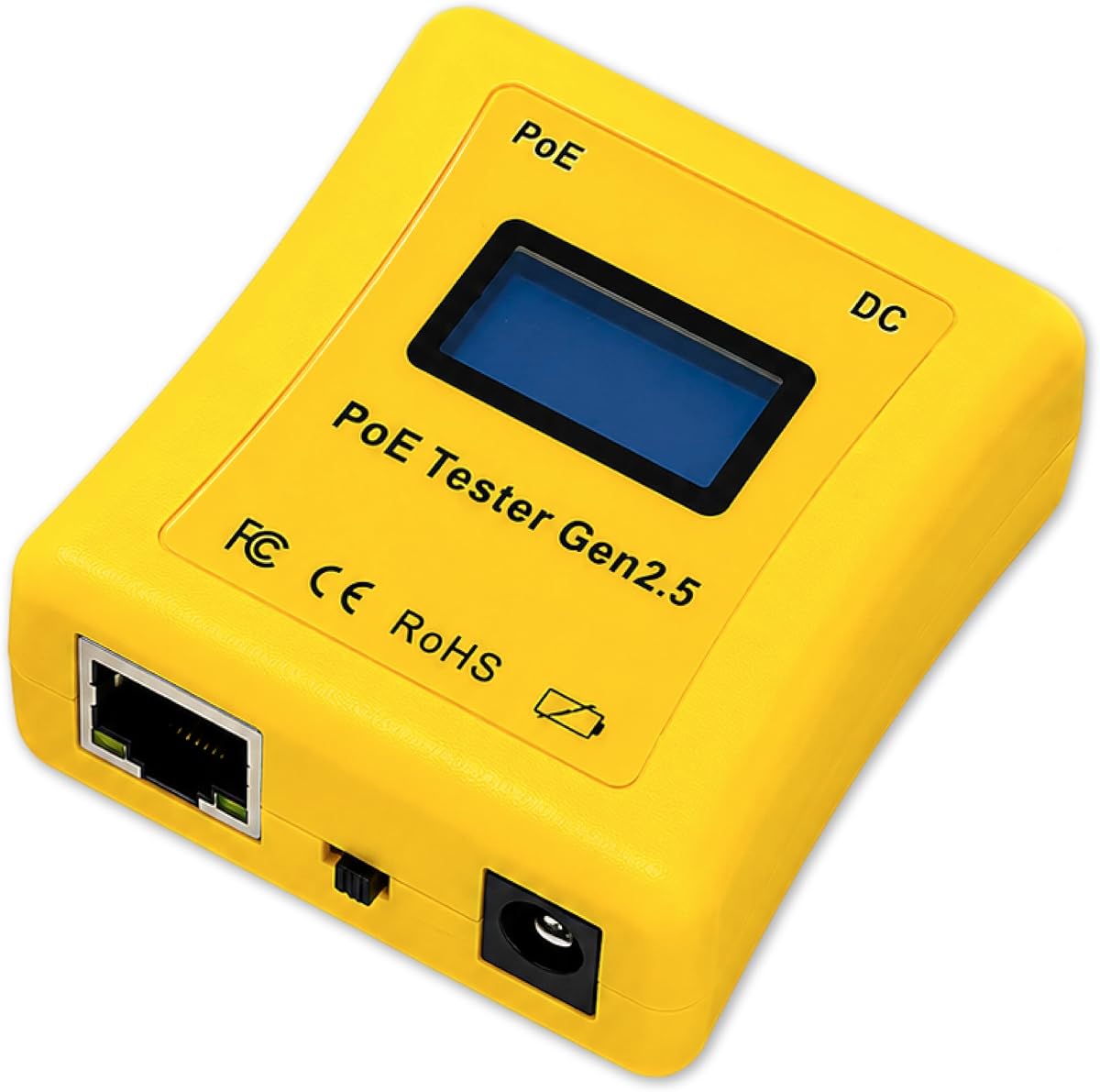
The PoE Texas GEN2.5 is a highly rated tool that offers exceptional performance at a competitive price point. Its ability to measure up to 280 watts makes it capable of handling the most demanding PoE applications available today. The ergonomic design ensures it fits comfortably in your hand or pocket for extended use.
We may earn a commission when you buy through this link, at no additional cost to you.
One of its main strengths is the infinite usage capability since it draws power from the PoE line itself. The LCD screen automatically cycles through voltage, current, and power readings, simplifying the workflow. It also activates ports on AF/AT/BT switches, allowing you to test equipment without a full device attached.
The main trade-off is that the display is functional but not as advanced as OLED or high-resolution color screens found in higher-end models. Additionally, brand recognition is lower than major manufacturers, which might affect support expectations. For most users, however, the functionality is the most critical factor.
This is a top recommendation for installers who need a durable, high-capacity tester. If you need to measure high wattage and prefer a tool that is easy to carry and never runs out of power, this model offers great value for the money.
Measuring up to 280 watts covers nearly every PoE device on the market. This ensures you are prepared for any future upgrades to your network.
The compact shape fits easily into a pocket, keeping your toolkit organized. This design is ideal for technicians who move between job sites.
We may earn a commission when you buy through this link, at no additional cost to you.
The NOYAFA NF-488 is a budget-friendly option that doubles as a comprehensive network cable tester and PoE detector. It is excellent for checking continuity and identifying loop-backs, which helps in diagnosing complex network issues quickly. The price point makes it accessible for small teams or individual contractors.
We may earn a commission when you buy through this link, at no additional cost to you.
It identifies standard and non-standard PoE information including voltage and polarity, and supports a 0-60V range. The remote wiring function helps detect open circuits and short circuits. The large backlit screen ensures results are visible in dark cable trays or closets.
The limitation here is that it is more of a diagnostic tool than a high-power monitor. It does not provide the same depth of wattage analysis as other models. If you need to monitor precise power consumption for complex setups, this might feel limited. However, for standard checks, it is efficient.
This tester is perfect for those who need a quick and reliable way to check both data and power lines. If you prioritize affordability and basic continuity checks alongside PoE detection, the NF-488 is a smart buy.
Its low price allows you to buy a unit for every technician on the team without breaking the budget. This ensures everyone has their own tool.
Checking for open and short circuits helps prevent installation errors. This feature saves time by identifying cable faults early.
We may earn a commission when you buy through this link, at no additional cost to you.
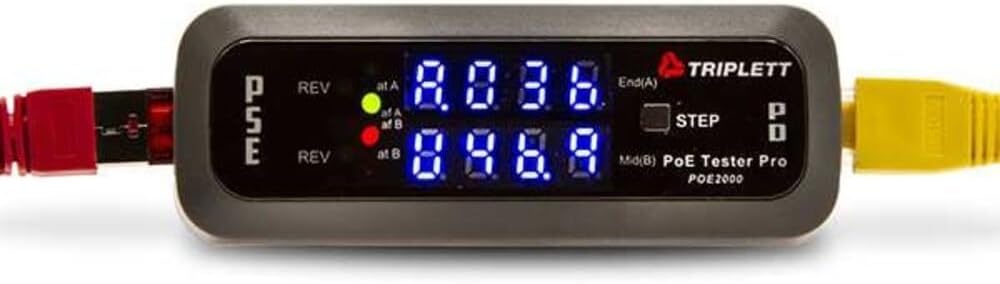
The Triplett POE2000 is a classic tool known for its simplicity and visual feedback system. It uses dual 7-digit LEDs to indicate power source types, which is helpful for quickly identifying if a connection is End Span or Mid Span. This visual approach reduces the need to read small text on a screen.
We may earn a commission when you buy through this link, at no additional cost to you.
It determines standard PoE versus non-standard passive PoE and indicates reversed polarity with yellow LEDs. The inline display alternates between Voltage, Current, and Power. While it functions well for basic tasks, the interface is less intuitive than modern models.
The main drawback is the rating and the older design. It lacks advanced features like wattage monitoring in detail or OLED screens. For technicians who prefer simplicity and reliable LED indicators over digital screens, this remains a useful tool. However, it may not meet the needs of those requiring detailed reports.
This tool is recommended for users who need a straightforward, no-nonsense PoE detector. If you value visual LED feedback and brand reliability over advanced digital features, the POE2000 is a solid choice.
The visual LEDs allow for quick identification of power sources. This reduces confusion in large rack environments.
Reversed polarity alerts protect devices from potential damage. This safety feature is critical for avoiding costly mistakes.
We may earn a commission when you buy through this link, at no additional cost to you.
The Triplett POE3000 is an advanced tester that provides detailed PSE class detection and standard support. It helps speed up installation by verifying that the power source matches the device requirements. The visual indicators clearly show IEEE802.3af or at/bt standards, which prevents compatibility errors.
We may earn a commission when you buy through this link, at no additional cost to you.
It incorporates a step button for selecting specific data to display. The inline power level monitoring is essential for ensuring devices receive enough power. The interface alternates between Voltage, Current, and Power. This is useful for technicians who need precise data to optimize network performance.
The higher price and complex interface may be overkill for simple checks. The tool requires a bit more time to learn compared to basic detectors. However, for professional installations where accuracy is paramount, the extra features justify the cost. It is a robust option for serious network engineers.
This model is ideal for professionals who need precise data on power standards and classes. If you require detailed analysis to ensure every device is powered correctly, the POE3000 offers the necessary precision.
Supporting all IEEE standards ensures compatibility with any device. This reduces the risk of installation failures.
Knowing the exact PSE class helps in planning power budgets. This is vital for large scale deployments.
We may earn a commission when you buy through this link, at no additional cost to you.
The Jonard Tools POE-1 is a comprehensive solution that combines PoE testing with cable continuity verification. It measures resistance to ensure flawless data transmission on various cable types. The kit includes a belt clip and cable remote, making it convenient for field technicians to carry.
We may earn a commission when you buy through this link, at no additional cost to you.
It verifies continuity for Cat5 through Cat6a cables and uses a battery-free operation mode powered by PoE or an included AA battery. This flexibility means it can test unpowered cables without relying on the PoE source. The resistance measurement helps identify faults that other testers might miss.
The inclusion of the battery option adds bulk and complexity to the design compared to purely passive tools. It might be heavier in your pocket. However, the ability to test unpowered cables is a significant advantage for troubleshooting where power is absent. This makes it a versatile all-in-one tool.
This tester is recommended for technicians who need to test both data and power integrity. If you value portability and a complete kit that covers multiple testing scenarios, the POE-1 is a strong candidate.
Measuring resistance helps identify cable faults that voltage alone cannot find. This adds a layer of diagnostic depth to your work.
The ability to use AA batteries allows testing on dead lines. This ensures you can always diagnose the issue.
We may earn a commission when you buy through this link, at no additional cost to you.
The PoE Cable Tester Pro stands out for its ability to measure cable length in addition to PoE verification. This is incredibly useful for installation verification where you need to confirm runs are within the 100m limit. It features a rechargeable battery that ensures extended usage without hunting for spares.
We may earn a commission when you buy through this link, at no additional cost to you.
It identifies shorts, opens, and miswires on both STP and UTP cables. The port flash detection helps locate active ports quickly. This functionality speeds up troubleshooting in complex network setups. The device is easy to use and has a low battery indicator to keep you informed.
The battery life is sufficient but not exceptional compared to self-powered models. For very long days, you might need to recharge. Also, the wattage data is not as detailed as other high-end models. However, for most standard installs, it provides the necessary data to complete the job.
This tool is perfect for installers who want to verify cable length and power delivery in one step. If you need a versatile tester that helps you find active ports and check cable health, the Pro model is a top pick.
Measuring cable length prevents signal loss issues. This feature helps you ensure every run is optimized.
Flash detection identifies active ports instantly. This saves time when tracing connections in busy racks.
We may earn a commission when you buy through this link, at no additional cost to you.
The Inline Cat5/6 DVM is a specialized tool that combines a multimeter with network testing capabilities. It is designed for users who need to check voltage and continuity with high precision. This is particularly useful for legacy systems that require specific diagnostic tools.
We may earn a commission when you buy through this link, at no additional cost to you.
It supports CAT5 and CAT6 standards and provides inline PoE testing. The DVM function allows for precise voltage readings. This is helpful when you need to troubleshoot specific power issues. The tool is robust but may lack the convenience of modern digital testers.
The price is higher than standard testers and it lacks advanced features like battery-free operation or OLED screens. It is best suited for technicians who already rely on multimeters and want an integrated solution. For modern high-speed networks, other options might be better suited.
This model is recommended for those who need multimeter precision alongside PoE testing. If you work on legacy or mixed networks where precise voltage measurement is critical, this tool offers a specialized capability.
Using a DVM function allows precise voltage checks. This helps in diagnosing issues that basic testers miss.
Supporting older cable standards ensures versatility. This is useful for maintaining older infrastructure.
We may earn a commission when you buy through this link, at no additional cost to you.
The NF-488 Network is a practical tool that combines network cable testing with DC appliance load testing. It measures up to 180W, which is sufficient for most standard PoE devices. The included LED lamp is a thoughtful addition that helps you see in dark closets and server rooms.
We may earn a commission when you buy through this link, at no additional cost to you.
It detects shorts, crossovers, and open circuits. The loop-back test helps diagnose network loops. The power detection range is useful for verifying DC devices. The lifetime customer service offers peace of mind for any issues that arise during use.
The power analysis is less detailed than advanced models. If you need precise wattage breakdowns for complex networks, you might find it lacking. However, for general installation and maintenance, the included lamp and loop-back test make it a very handy tool. The service support is also a major plus.
This tester is recommended for users who want a well-rounded tool with extra utilities like a lamp. If you value service support and a device that checks both data and power loops, this is a solid option.
The LED lamp helps in dark environments. This saves you from needing a separate flashlight during work.
Testing loops prevents network broadcast storms. This feature is critical for maintaining network stability.
We may earn a commission when you buy through this link, at no additional cost to you.
Choosing the right Inline POE Tester depends on your specific needs regarding power standards, display quality, and additional testing functions. This guide breaks down the most important factors to consider before you buy.
Ensure the tester supports the modes you need such as PD mode to simulate devices, Inline mode to pass-through test, and DC mode for non-PoE power. This versatility allows you to troubleshoot different types of power sources effectively.
Look for a device that offers flexible modes to cover various installation scenarios without needing multiple tools.
Check that the device supports IEEE 802.3af, at, and bt standards to ensure it can handle high wattage devices like modern cameras. Support for passive PoE is also important if you work with older or non-standard equipment.
A tester with wide standard support will future-proof your toolkit against new hardware upgrades.
The display quality matters when working in low light or bright sunlight. OLED screens offer the best visibility, while backlit LCDs are also effective. Consider if you need detailed data on a single screen or if cycling is acceptable.
Choose a display that matches your working environment to reduce eye strain and errors.
Decide between battery-free models that draw power from the line or those that use batteries or AA cells. Battery-free options are great for long-term use, but batteries offer testing on unpowered lines.
Prioritize battery-free for convenience unless you need to test dead cables frequently.
Some testers include RJ45 continuity checking to detect opens, shorts, and miswires. This is useful for verifying cable integrity before applying power. It saves time by preventing you from powering faulty cables.
Look for continuity features if you need a one-stop tool for both data and power checks.
A compact and lightweight design is essential for technicians who carry many tools. Look for ergonomic shapes and belt clips. The smaller the device, the easier it is to use in tight spaces.
Choose a pocket-sized option to improve ease of use on job sites.
A reputable manufacturer often provides better warranty and technical support. Check if the device comes with a warranty period. Good support can save you money if the device fails.
Select a brand with reliable support to ensure you are covered in case of issues.
For government or secure projects, verify if the tester is NDAA compliant. This ensures you are not using prohibited equipment. It is a critical factor for contractors working in the U.S. and Canada.
Always check compliance requirements for your specific projects to avoid delays.
To use the tester, connect one end to your power source and the other to your device or port. Turn on the display to see real-time voltage, current, and power readings. Use the step button to cycle through data or lock a specific reading.
After use, unplug the device and store it in a protective case. Keep the contacts clean to avoid poor connections. If your model uses batteries, remove them if storing for long periods.
Periodically check the accuracy of your tester against known standards to ensure it is functioning correctly. Avoid dropping the device or exposing it to water or dust beyond its rating.
An Inline POE Tester is a diagnostic tool that measures voltage, current, and power flowing through Ethernet cables. It is used by network technicians to verify power delivery from switches or injectors to devices.
Many modern testers are battery-free and draw power directly from the PoE line. However, some models use batteries to test unpowered cables or to provide additional features like lighting.
Yes, most of the top-rated testers support both standard and passive PoE. They detect voltage ranges like 12-57V to confirm compatibility with older or non-standard equipment.
NDAA compliance ensures that the equipment does not contain prohibited components. This is required for government and secure network projects in the U.S. and Canada to meet legal standards.
Some models include cable continuity testing to detect opens, shorts, and miswires. This helps verify the physical integrity of the network cable alongside power delivery.
Inline mode measures power passing through to a device. PD mode simulates a powered device to test if the switch or injector is delivering power correctly without a real device attached.
It is recommended to check accuracy periodically against known standards. If you notice inconsistent readings, calibration may be required. Most professional tools require annual checks.
We have reviewed ten top Inline POE Testers, ranging from budget-friendly options to advanced models with OLED displays. The TRENDnet TC-NTP1, PoE-T100, and PoE Texas GEN2.5 offer excellent value and performance for most users.
When selecting a tool, consider the power standards you need to support, the display clarity, and whether you require cable continuity features. Prioritize models that save you time and offer the reliability you need for daily work.
Prices and availability are subject to change. Always verify the latest details and features before purchasing to ensure the tool meets your specific requirements.