
Mcbazel 3 in 1
4.5Editor score
Affordable price point
Wind temperature sensing
Compact portable design
This comprehensive guide compares the top 10 Marine Anemometers for 2026, evaluating accuracy, durability, and features to help you find the perfect device for
Navigating safely requires precise wind data, and the right Marine Anemometer delivers exactly that. Whether you are racing or cruising, understanding wind speed and direction is critical for performance and security on the water.
We evaluated ten top-rated models based on accuracy, build quality, and ease of use. Our analysis covers handheld devices for casual sailors and integrated systems for serious racing vessels to ensure you find the best fit.
Each pick highlights specific strengths and ideal use cases for different boating needs. Prices and availability fluctuate frequently, so verify current details before purchasing to ensure you get the best value for your investment.
4.5Editor score

4.5Editor score

4.4Editor score
The following table provides a side-by-side comparison of all ten selected Marine Anemometers to help you quickly identify the most suitable device for your specific boating requirements.


The BTMETER BT-100 is a versatile handheld device rated 4.5 stars for its accuracy and portability. It serves as an excellent tool for sailors needing precise wind data without investing in a full boat system.
We may earn a commission when you buy through this link, at no additional cost to you.
Its standout feature is the range of five measurement units, from knots to meters per second. The two temperature sensors and eight vanes ensure sensitive readings, crucial for understanding subtle wind shifts on the water.
While the housing is primarily plastic, it includes a carrying case and tripod hole. The battery life is decent but could be improved for extended voyages. However, the included batteries provide a quick start.
This model is ideal for small boat owners and recreational sailors. It offers professional-grade features at an accessible price point, making it a top recommendation for those seeking reliable wind data.
The eight vanes and dual sensors provide high-resolution readings down to 0.1 m/s, ensuring you catch even light breezes.
A metal threaded hole on the base allows you to fix the unit on a tripod for continuous monitoring without holding it.
We may earn a commission when you buy through this link, at no additional cost to you.
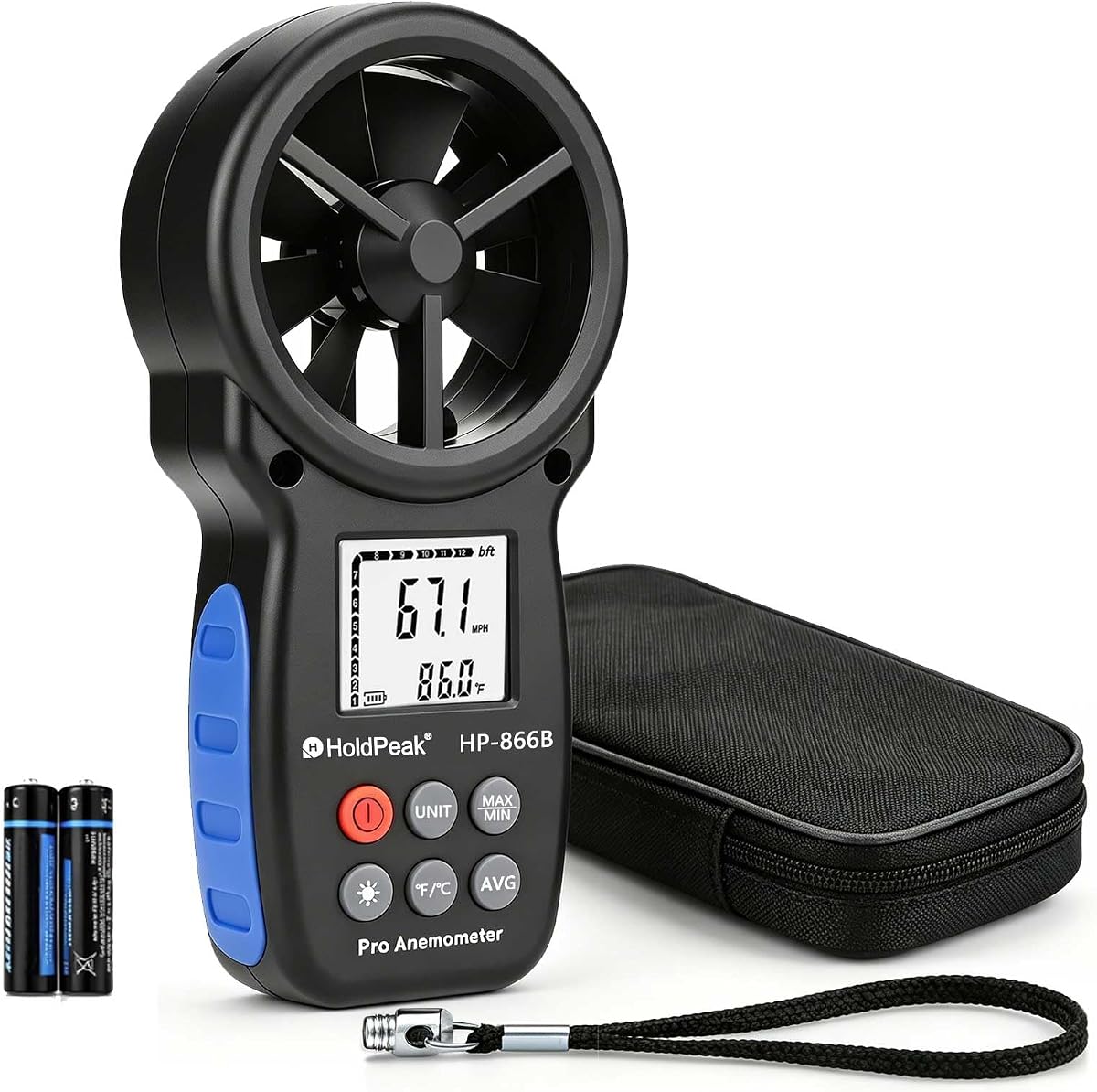
The HoldPeak 866B is a robust handheld anemometer with a 4.5 star rating. It is designed for reliability and ease of use in various outdoor and marine environments.
We may earn a commission when you buy through this link, at no additional cost to you.
Its key strength lies in the included hand strap and waterproof carrying pouch. These features ensure the device stays secure and protected during active sailing, preventing drops or water damage.
The Max/Min/Average wind speed function helps track gusts over time, which is vital for sailing decisions. However, the display is slightly small for quick reading in bright sunlight.
This model is perfect for active sailors who need a durable tool. It balances performance and protection, making it a strong choice for both beginners and experienced boaters.
The included hand strap prevents accidental drops, ensuring safety while you maneuver on a moving deck.
Use the Max Min Average function to monitor wind gusts and determine the safest sailing conditions.
We may earn a commission when you buy through this link, at no additional cost to you.
The Magnetic Mount Anemometer by Inspeed stands out with a 4.7 star rating for its convenient setup. It offers a unique solution for sailors who want quick deployment without complex mounting.
We may earn a commission when you buy through this link, at no additional cost to you.
The calibrated sensor ensures reliable data, while the magnetic base allows for instant attachment to metal surfaces on a boat. This flexibility makes it ideal for temporary testing or multi-vessel use.
While the price is higher than basic handhelds, the convenience and accuracy justify the cost. Limited unit options might be a drawback for international users, but core performance is solid.
This device is best for sailors who need a portable, easy-to-install wind meter. Its magnetic convenience and calibrated precision make it a smart choice for modern boat setups.
Strong magnets allow for instant placement on metal surfaces, saving time compared to traditional mounting.
Factory calibration ensures high accuracy right out of the box, reducing the need for manual adjustments.
We may earn a commission when you buy through this link, at no additional cost to you.
The Raymarine I60 Display is a specialized unit with a 3.9 star rating. It is intended solely for sailors upgrading existing systems rather than those starting from scratch.
We may earn a commission when you buy through this link, at no additional cost to you.
Its high contrast text and adjustable backlight ensure readability in all lighting conditions. The compact design fits standard instrument panels, making it a seamless addition to modern boats.
However, the display requires a separate masthead transducer to function. This limitation increases the total cost and complexity, and the lower rating reflects potential compatibility or usability issues.
This product is best for upgrading existing Raymarine systems. If you need a clear, reliable readout for your boat network, it is a functional choice, provided you already have sensors.
High contrast graphics and adjustable backlighting ensure wind data is visible even in bright sun or total darkness.
Designed to work seamlessly with Raymarine NMEA networks, integrating well with other onboard instruments.
We may earn a commission when you buy through this link, at no additional cost to you.
The TopTes TS-301 is a user-friendly handheld anemometer with a 4.6 star rating. It features a large screen and humidity sensor, making it versatile for various boating and weather conditions.
We may earn a commission when you buy through this link, at no additional cost to you.
Its standout feature is the 2.26-inch backlit LCD, which provides clear readings in any light. The humidity sensor adds value for understanding dew points, crucial for condensation or fog prediction.
The auto shut off feature saves battery, but the device may take 30 minutes to adjust to new temperatures. This warm-up time can delay immediate readings during quick checks.
This device is ideal for sailors who prioritize readability and extra environmental data. The large screen and humidity monitoring make it a practical tool for diverse sailing and weather needs.
The 2.26-inch backlit LCD ensures all data is visible at a glance, reducing eye strain during long trips.
Measuring relative humidity helps predict fog or condensation, offering extra value for weather planning.
We may earn a commission when you buy through this link, at no additional cost to you.
The Raymarine E28081 is a specialized replacement part rated 4.1 stars. It provides essential bowl and vane assemblies for upgrading or repairing existing Raymarine ST50 and ST60 systems.
We may earn a commission when you buy through this link, at no additional cost to you.
Its primary strength is maintaining the integrity of your instrument setup. Using original parts ensures accuracy and longevity compared to third-party replacements. The included screws and key simplify installation.
As it is a parts kit rather than a full device, it is not for new users. Limited compatibility restricts it to specific older Raymarine models, which may limit broader appeal.
This item is essential for owners of older Raymarine systems needing repairs. It restores reliability and performance to your existing wind instrument network efficiently.
Genuine Raymarine components ensure your instrument maintains factory accuracy and longevity after repairs.
Includes all necessary fixings and tools, making it a convenient solution for quick field or workshop repairs.
We may earn a commission when you buy through this link, at no additional cost to you.
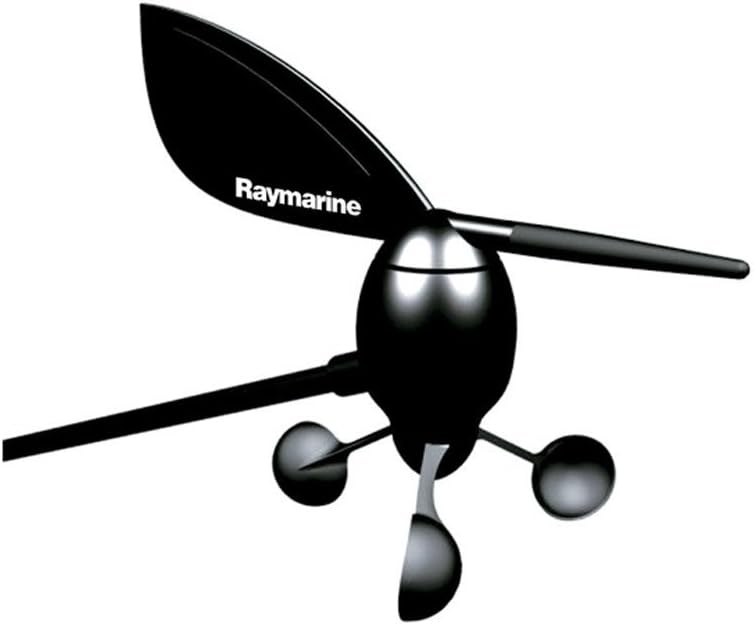
The RAYMARINE MASTHEAD unit is a specialized component with a 4.4 star rating. It offers a latest-version wind arm and cups for sailors upgrading their masthead sensor assembly.
We may earn a commission when you buy through this link, at no additional cost to you.
Its key strength is the updated design which likely improves accuracy and durability over older models. Replacing just the masthead is cost-effective compared to buying a full new system.
However, it is expensive and requires physical work on the mast, which may be difficult for some. The cost and installation effort are significant trade-offs for a single component.
This product is ideal for owners of older systems needing a modernized sensor. It extends the life of your existing display network with a robust and accurate update.
Upgrading to the latest version ensures better performance and reliability compared to older masthead units.
Buying the masthead unit only is often more affordable than replacing the entire wind instrument system.
We may earn a commission when you buy through this link, at no additional cost to you.
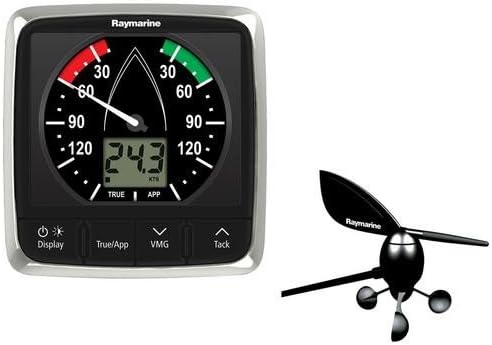
The Raymarine i60 Wind System is a premium full package rated 4.4 stars. It includes the masthead transducer and display, offering comprehensive wind data for serious sailors.
We may earn a commission when you buy through this link, at no additional cost to you.
Its standout feature is the VMG and tack display, essential for racing. The 30-meter cable ensures flexible installation, while the low power usage and red backlighting support extended trips.
The high price and complex setup are trade-offs. It requires more installation effort than handhelds, and the cost may be prohibitive for casual users who do not need advanced data.
This system is best for racing boats or cruisers needing integrated performance. It provides precise wind data and tactical features that significantly enhance sailing speed and safety.
Displays VMG and tack information to help optimize your course and speed during races.
A 30-meter cable allows versatile positioning on various boat sizes without signal issues.
We may earn a commission when you buy through this link, at no additional cost to you.
The Raymarine i60 Wind Display System is a high-end package focused on detailed wind analysis. It offers true and apparent wind angle data, essential for precise navigation and sail trim.
We may earn a commission when you buy through this link, at no additional cost to you.
Its key strength is the comprehensive display options, allowing you to customize fields. The masthead transducer is engineered for saltwater resistance, ensuring reliability in harsh marine environments.
The lack of a rating and high price point may deter casual sailors. The controls are intuitive, but the system is complex and requires proper integration to function correctly.
This product is ideal for serious sailors needing precise wind data. The true wind angle and customizable display provide advanced tools for optimizing performance and navigation.
Displays both true and apparent wind angles to help you understand the exact wind vector relative to your boat.
Adjustable backlighting and customizable screen fields ensure you see the exact data you need when you need it.
We may earn a commission when you buy through this link, at no additional cost to you.
The Mcbazel 3 in 1 is an affordable anemometer with a 4.5 star rating. It balances cost and functionality, offering wind speed, temperature, and Beaufort scale readings.
We may earn a commission when you buy through this link, at no additional cost to you.
Its standout feature is the Beaufort scale, which simplifies wind intensity understanding for beginners. The double line LCD displays data simultaneously, and auto power off saves battery life effectively.
The basic build and lack of included batteries are trade-offs. While functional, it may not withstand heavy industrial use, but it is perfect for casual sailing or home checks.
This device is ideal for budget-conscious sailors or beginners. It delivers essential wind data without unnecessary complexity, making it the best value option on this list.
Simplifies wind intensity interpretation by displaying the Beaufort scale alongside numerical speed data.
Auto power off preserves battery life, ensuring the device is ready when you need it.
We may earn a commission when you buy through this link, at no additional cost to you.
Selecting the right Marine Anemometer depends on your specific boating needs and budget.
High resolution ensures you can detect subtle wind shifts that impact sailing performance. Look for devices with at least 0.1 m/s resolution for reliable data.
Prioritize models with calibrated sensors to ensure your wind speed and direction readings are trustworthy.
Different regions and sailing contexts require different units. Ensure the device supports knots for maritime use and meters per second for scientific accuracy.
Check for easy unit switching to avoid conversion errors while you are actively sailing or racing.
Handheld units offer portability but may be hard to manage on a moving deck. Devices with tripod holes or magnetic mounts allow for continuous monitoring.
A secure mounting system ensures stability during rough seas, preventing data loss or device damage.
Backlit LCD screens are crucial for reading data in low-light conditions or at night. Large displays reduce eye strain and allow quick glances.
Ensure the screen contrast is high enough to remain visible even in direct sunlight.
Marine environments expose devices to saltwater and UV rays. Look for saltwater-resistant or waterproof designs to prevent corrosion.
A sturdy housing protects internal sensors from impact damage during active sailing.
Long battery life is essential for extended trips. Features like auto power-off help conserve energy during periods of non-use.
Check if batteries are included and consider the availability of replacements for your chosen model.
Some anemometers include temperature and humidity sensors, providing a complete weather picture. This data helps predict fog or condensation.
Consider these extra features if you need comprehensive environmental monitoring beyond wind speed.
For serious sailors, integration with onboard systems is key. Choose models that support NMEA protocols to share data with charts and instruments.
Compatibility ensures your wind data contributes to a cohesive navigation and performance network.
To get the most accurate readings, ensure the device is calibrated before each trip. Position the anemometer in an open area away from structures to avoid turbulent wind readings.
Rinse handheld units with fresh water after every saltwater exposure to prevent corrosion. Store them in a dry, cool place when not in use to protect the electronics.
Regularly replace batteries to avoid data loss. For integrated systems, check connections and cables periodically to ensure secure signal transmission.
True wind is the actual wind moving over the Earth's surface, while apparent wind is the wind you feel on the boat, combining true wind with the boat's speed. Accurate anemometers help calculate both for better sail trim and navigation decisions.
For professional racing or large boats, a masthead sensor provides the most accurate data by capturing wind above obstructions. Handheld units are fine for casual sailing but may be affected by the boat's structure.
Rinse the exterior with fresh water and use a soft cloth to wipe it dry. Avoid high-pressure hoses on electronic displays or sensors to prevent water ingress.
The Beaufort scale is a measure of wind force based on sea conditions. Anemometers that display this scale help sailors quickly estimate wind intensity without converting units.
Yes, handheld models are portable and can be used on any vessel. However, they may not be as convenient as fixed systems for continuous monitoring during long voyages.
It is recommended to calibrate your anemometer at least once a year or after a major impact. Regular checks ensure the readings remain accurate for safe navigation.
We explored ten top Marine Anemometers ranging from budget-friendly handhelds to integrated racing systems. Each device offers unique strengths for different sailing needs and environments.
Prioritize accuracy, durability, and display readability based on your typical sailing conditions. A reliable wind data tool is essential for optimizing performance and ensuring safety on the water.
Prices and availability change frequently, so verify current deals before purchasing. Choosing the right model ensures you have reliable wind data for every journey ahead.