
Elitech Refrigerant Leak Detector CLD-100
4.3Editor score
Traditional corona sensor
Six adjustable settings
Flexible eight inch probe
Discover the top Freon Leak Detector Tool options for HVAC professionals. This guide compares sensors, sensitivity, and features across ten leading models.
Finding the right Freon Leak Detector Tool is essential for HVAC technicians and DIYers alike. A quality detector helps locate refrigerant leaks quickly, saving time and preventing system damage during routine maintenance tasks.
We evaluated ten top-rated detectors based on sensor type, sensitivity levels, battery life, and ease of use. Our analysis covers affordable options for homeowners and professional-grade tools for commercial service work.
Each pick highlights key strengths and trade-offs to help you choose the best fit. Prices and availability change frequently, so verify current details before purchasing your preferred leak detection device.
4.3Editor score

4.4Editor score
4.4Editor score
This side-by-side comparison highlights key specifications and capabilities across all ten selected Freon Leak Detector Tool models. Review sensor technologies and design features to find the right match for your specific HVAC needs.



This rechargeable HVAC refrigerant detector stands out as a top choice for technicians needing reliable leak detection. It earned a 4.4-star rating for its robust performance and user-friendly design. The live PPM readings offer precise feedback that helps locate leaks faster than simple alarm indicators.
We may earn a commission when you buy through this link, at no additional cost to you.
The Japanese metal-oxide sensor responds to the full halogenated refrigerant family, covering everything from legacy CFCs to modern HFOs. Users can switch between high and low sensitivity to sweep areas broadly before zeroing in on specific joints. The large color LCD displays concentration levels clearly, reducing guesswork during inspections.
One trade-off is the warmup time required for the sensor to reach full sensitivity, which means leaving it on in clean air before use. Additionally, effective detection requires moving the probe slowly, about one inch per second, to avoid missing small leaks. These are acceptable compromises for the accuracy gained.
HVAC professionals and serious DIYers who value precision will appreciate this tool. It balances cost and performance well, making it a strong recommendation for routine maintenance and troubleshooting tasks where reliability matters most.
With US-based customer service and technical support, buyers feel confident in their purchase. The rechargeable battery eliminates the need for disposable cells, ensuring the tool is always ready for emergency calls.
The large color LCD shows actual concentration in parts per million, letting you watch numbers climb as you approach a leak source.
Both SFD200 and SFD201 models respond to full halogenated refrigerant families including CFCs, HCFCs, HFCs, and HFOs.
We may earn a commission when you buy through this link, at no additional cost to you.
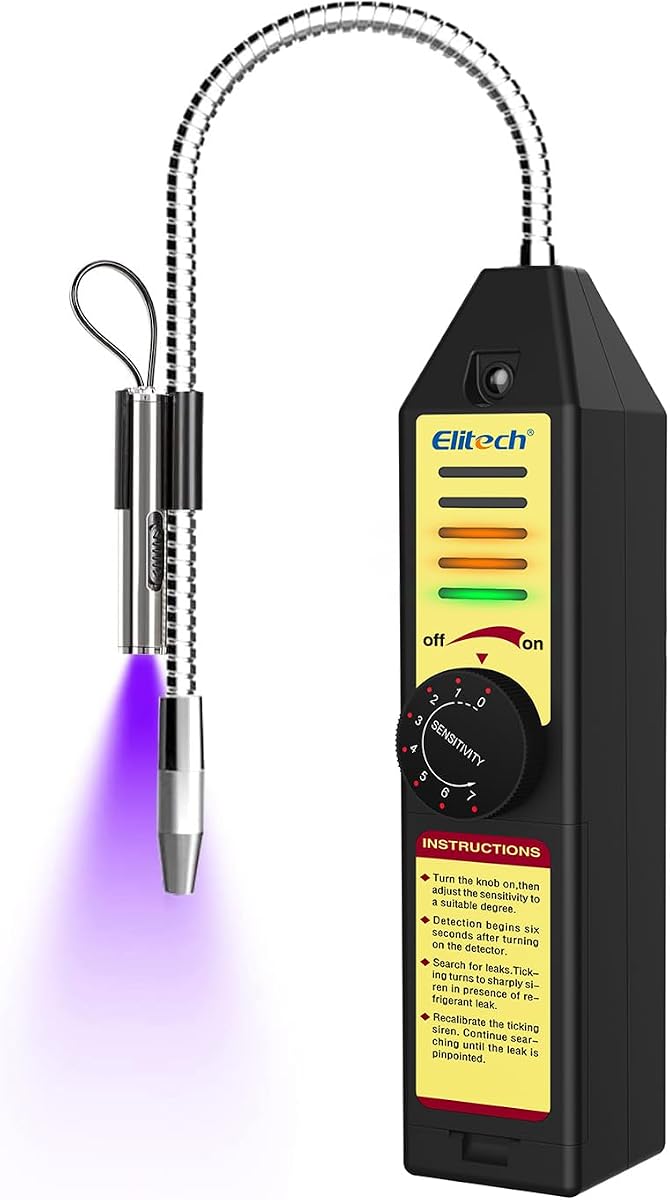
The Elitech CLD-100 offers an affordable entry into leak detection without sacrificing core functionality. With a 4.3-star rating, it is a favorite for homeowners and entry-level technicians. Its upgraded corona sensor provides quick response on common refrigerants like R134a and R410A.
We may earn a commission when you buy through this link, at no additional cost to you.
This model features six sensitivity levels, allowing users to adjust based on leak size and environment. The flexible probe measures around 8.26 inches, making it easy to reach tight spots in vehicle AC units or household systems. Direct status indication via visual and audible alarms ensures you never miss a signal.
A limitation is that the unit uses four AAA batteries not included, which adds to initial costs. It is also less sensitive compared to infrared or heated diode options, so micro leaks might require closer inspection. However, for general maintenance, this performance is sufficient.
Budget-conscious buyers seeking a reliable tool for occasional use will find this model appealing. It delivers essential features at a fraction of the cost of professional gear, making it ideal for DIY repairs and basic HVAC checks.
The flexible probe design enhances accessibility in hard-to-reach areas. This practical feature saves time and effort during inspections, ensuring you can check valves and joints without disassembling components unnecessarily.
An 8.26-inch flexible probe allows detection in difficult and hard-to-reach areas without needing extra tools.
Dual color battery indicators alert you to power levels so you are not caught off guard during a job.
We may earn a commission when you buy through this link, at no additional cost to you.
The Elitech ILD-100H brings heated diode technology to the mid-range market, offering better accuracy than traditional corona sensors. It holds a 4.4-star rating for its performance and ease of use. The TFT screen provides clear readings on sensitivities and battery levels during operation.
We may earn a commission when you buy through this link, at no additional cost to you.
This detector can identify all kinds of halogen refrigerants including CFCs, HFCs, HCFCs, and mixed refrigerants like R410A. Its adjustable sensitivity offers high, medium, and low levels, reaching up to 0.1oz/yr for micro leak detection. Two front buttons allow quick adjustments or muting the buzzer directly.
While more expensive than basic models, the improved sensor technology justifies the cost for frequent use. Some users note battery life varies based on usage patterns, so carrying spares is wise. These minor issues do not detract from its overall value.
Technicians needing a balance of portability and performance will appreciate this unit. It is suitable for automotive AC repair and residential HVAC maintenance where quick and accurate detection is essential.
A one-year warranty and seven-day support ensure peace of mind. The heated diode sensor provides consistent results even in varying environmental conditions.
Compared to traditional sensors, heated diode technology delivers more accurate results for all halogenated refrigerants.
First leak detector with a TFT screen gives more clear and easy readings on key info during operations.
We may earn a commission when you buy through this link, at no additional cost to you.
The Elitech ILD-200 features an infrared sensor that boasts a 10-year service life, a significant advantage over other technologies. With a 4.4-star rating, it is built for professionals who need longevity. Infrared detection offers stronger anti-interference ability compared to heated diode options.
We may earn a commission when you buy through this link, at no additional cost to you.
Sensitivity is adjustable with high, medium, and low levels, reaching up to 0.14oz/yr. The 2.8-inch large screen ensures no leakage is missed, with peak display clearly indicating orientation. Users can maintain a quiet working environment with mute capabilities.
The unit is slightly heavier than entry-level detectors due to the advanced sensor. It also sits in a higher price bracket, which might be a barrier for casual users. However, the durability offsets the cost over time for daily users.
Professionals seeking a durable tool for commercial HVAC and automotive applications should consider this model. It provides accuracy and stability that justify the investment for serious technicians.
US local R&D and service teams ensure prompt support. This commitment to customer care adds value beyond the hardware itself.
Infrared leak detectors have strong anti-interference ability and faster response speed compared to heated diode types.
The peak display clearly indicates the orientation of the leak detection point for users needing focused accuracy.
We may earn a commission when you buy through this link, at no additional cost to you.
The Elitech WJL-6000S is a straightforward tool designed for quick detection across a wide range of refrigerants. It holds a 4.2-star rating for its reliability in automotive and home AC testing. Response is within 3 seconds, with warm-up in 6 seconds.
We may earn a commission when you buy through this link, at no additional cost to you.
It detects all halogenated refrigerants including R22, R134A, R410A, and R1234YF. Seven adjustable sensitivity levels provide flexibility for different leak sizes. Multiple indicators include audible and visual alarms along with battery status displays.
The screen is functional but lacks the color displays of higher-end units. It relies on standard batteries, which means ongoing replacement costs. For simple tasks, these limitations are acceptable.
DIYers and technicians who need a no-fuss detector will find this unit adequate. It offers core functionality without complex interfaces, making it easy to operate in the field.
The flexible probe allows detection in difficult and hard-to-reach areas. This practical design helps avoid unnecessary disassembly when checking for leaks in tight vehicle engine bays.
The electronic refrigerant leak detector response within 3 seconds with warm-up in 6 seconds, the shortest time in gas detectors.
Equipped with audible and visual gas leakage indicators plus dual battery indicators for comprehensive feedback.
We may earn a commission when you buy through this link, at no additional cost to you.
This rechargeable detector combines modern connectivity with high-precision sensing. With a 4.7-star rating, it is a top contender for tech-savvy users. The full-color TFT display provides real-time PPM readings and leak intensity visualization.
We may earn a commission when you buy through this link, at no additional cost to you.
It features a Japanese semiconductor sensor with three sensitivity levels up to 0.1oz/yr. Three alarm modes (sound, light, vibration) can be enabled independently, offering flexibility for noisy or quiet environments. The 14.5-inch flexible gooseneck probe reaches tight spaces easily.
Battery life is around 8 hours on a full charge, which covers a typical workday. Some users may find the menu navigation takes time to master. Overall, these are minor trade-offs for the feature set.
Professionals needing a versatile tool for HVAC and auto AC will appreciate the detailed feedback. The rugged housing ensures durability on job sites while maintaining comfortable handling.
USB-C charging makes recharging simple. The battery status display helps prevent power loss during critical inspections.
Sound, light, and vibration alerts can be enabled or disabled independently for flexibility in different job sites.
Switch between funnel view and trend graph to monitor leak level changes over time accurately.
We may earn a commission when you buy through this link, at no additional cost to you.
The ALD-200 targets professionals with next-generation heat diode sensors capable of A1, A2L, and A3 refrigerant detection. It holds a 4.3-star rating for its versatility in modern systems. The 2.8-inch TFT color display ensures optimal visibility in various lighting.
We may earn a commission when you buy through this link, at no additional cost to you.
Sensitivity is adjustable up to 0.14 oz/yr, pinpointing micro leaks soap bubbles might miss. Intelligent features include Peak Mode to capture max readings and Reset Function to minimize false alarms. The oil-resistant housing withstands harsh job site conditions.
Full recharge takes time before first use, and sensor warm-up is required for accuracy. This adds to setup time but ensures reliable performance. These steps are standard for professional tools.
Technicians working with newer A2L refrigerants like R32 or R454B will find this detector essential. It delivers precision comparable to high-end models at a fraction of the cost.
Peak Mode helps track leakage intensity. Reset Function recalibrates the sensor to maintain consistent readings over time.
Covers A1, A2L, and A3 refrigerants with true 3-in-1 detection capability including R32, R454B, and more.
Peak Mode captures maximum leakage reading while Reset Function minimizes false alarms by recalibrating sensor.
We may earn a commission when you buy through this link, at no additional cost to you.
This detector boasts a 4.9-star rating for exceptional sensitivity and user feedback. It supports three sensitivity levels, reaching 3g/yr for accurate leak location. Real-time bar graph display shows concentration levels intuitively.
We may earn a commission when you buy through this link, at no additional cost to you.
Audible buzzer, vibration alarm, and screen indication help locate leaks even in noisy environments. Intensity of the leak is directly proportional to sound frequency. Includes a mute function and reset calibration for daily use.
The auto-off feature after 30 minutes may be too short for long inspections. Some users note weight distribution can be uncomfortable during extended use. These are minor compared to the performance benefits.
For those requiring high sensitivity for small leaks, this model is a strong candidate. It suits family users and professional technicians needing a portable solution.
Comes with a carrying bag for safe transport. The 3000mAh battery offers over 6 hours of continuous operation.
The intensity of the leak is directly proportional to the sound and vibration frequencies for immediate feedback.
Comes complete with a Type-C charging cable, carrying bag, and user manual for reliable field use.
We may earn a commission when you buy through this link, at no additional cost to you.
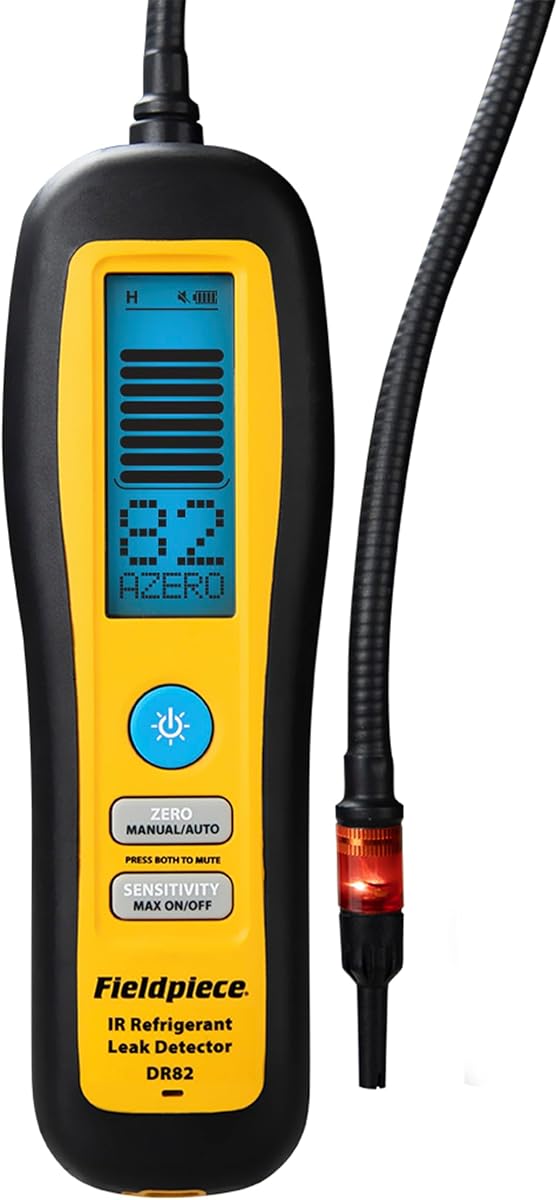
Fieldpiece DR82 sets a benchmark with ultra-sensitive infrared technology that finds leaks under 0.03 oz/yr. It earns a 4.4-star rating for professional-grade reliability. Compatible with all refrigerants from CFC to HFO blends.
We may earn a commission when you buy through this link, at no additional cost to you.
The sensor is IP54 rated and resists moisture and oil. A backlit LCD shows size and intensity clearly. LED tip and beep help pinpoint leaks easily. A 17-inch probe reaches tight spaces effectively.
The high price point is a barrier for casual users. Some find it heavier than expected. However, for commercial work, these trade-offs are justified by the longevity and precision.
Professionals requiring a durable, ultra-sensitive tool should invest here. It ensures minimal false negatives and maximum efficiency for HVACR tasks.
USB-C battery life exceeds 10 hours, ensuring all-day use. Replaceable filter tips maintain sensor integrity over time.
Ultra-sensitive infrared finds less than 0.03 oz/yr leaks, 20x more sensitive than bubbles.
Durable IP54 rated sensor resists moisture and oil with a 10-year service life ensuring reliability.
We may earn a commission when you buy through this link, at no additional cost to you.
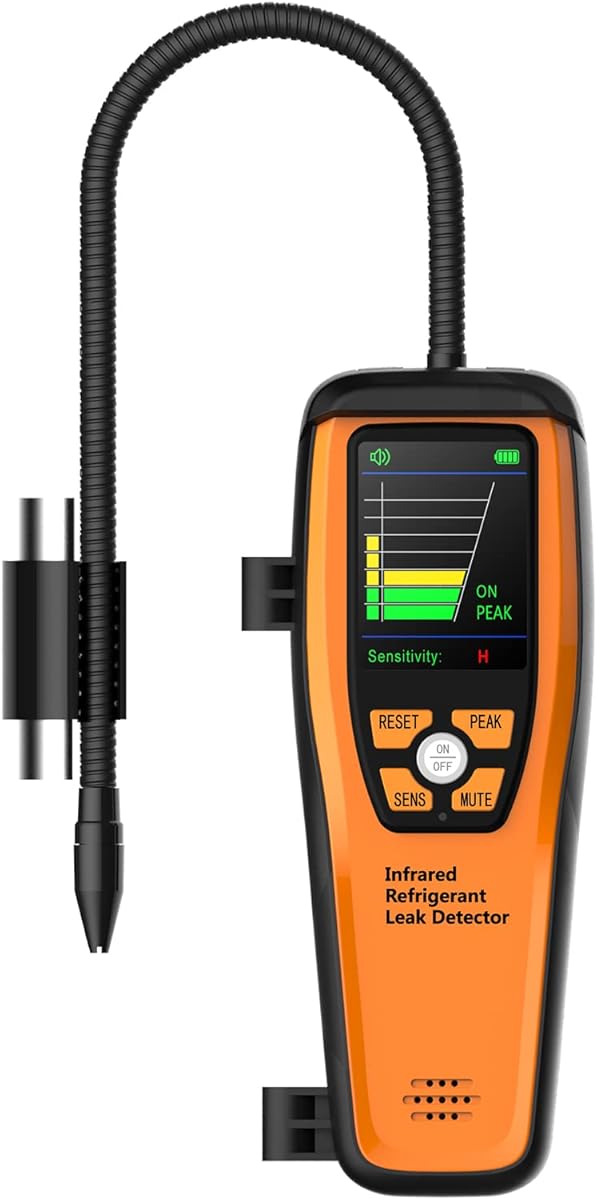
The TOPTES RT-389 is an orange-colored rechargeable detector with a vibrant TFT display. It holds a 4.1-star rating for its user-friendly design. Adjustable sensitivity modes include High, Middle, and Low up to 0.1oz/yr.
We may earn a commission when you buy through this link, at no additional cost to you.
Triple alarm modes (sound, visual, vibration) offer flexibility. Dual display modes switch between curved funnel and curve graph for tracking trends. Built-in top light enhances visibility in low-light conditions.
Some users note the weight may cause fatigue over long periods. Auto screen-off helps conserve battery but may interrupt long checks. These are manageable with practice.
Technicians who prefer visual tracking of leak trends will appreciate the curve graph. It is waterproof, explosion-proof, and dustproof, ensuring reliability in harsh environments.
Ergonomic easy-grip design ensures comfortable handling. A storage case is included for transport.
Switch between a curved funnel chart for real-time levels and a curve graph for tracking trends over time.
Built with high-strength engineering plastic ensuring waterproof, explosion-proof, and dustproof reliability.
We may earn a commission when you buy through this link, at no additional cost to you.
Selecting the right detector involves balancing performance, budget, and specific refrigerant needs. This guide outlines key factors to consider before purchasing.
Sensor type determines accuracy and sensitivity. Metal-oxide sensors offer good value, while infrared provides high stability. Heated diode sensors are a middle ground for accuracy and cost.
Choose sensor technology that matches your typical work environment and required detection limits.
Ensure the detector supports all refrigerants used in your HVAC or automotive systems. Modern tools should handle HFCs, HCFCs, and new A2L blends like R32.
Check manufacturer specs for full halogenated refrigerant family coverage before purchase.
Adjustable sensitivity allows users to switch between broad sweeps and precise pinpointing. Higher sensitivity models can detect leaks as low as 0.1oz/yr.
Look for units with at least three sensitivity settings for versatility across different job conditions.
Rechargeable lithium batteries offer convenience but may limit runtime. Traditional AAA batteries allow swapping but add ongoing costs. USB-C charging is increasingly standard.
Prioritize units with battery status indicators and reasonable runtime for your typical usage duration.
Flexible probes help reach tight spots in engine bays or around coils. Rigid probes may be more durable but less versatile.
Opt for a flexible probe with sufficient length to avoid disassembly of HVAC components.
Audible alarms, vibration, and visual indicators work together to alert users in noisy environments. Mute functions are crucial for quiet work zones.
Ensure the detector offers customizable alerts to prevent false positives during complex repairs.
Field tools must withstand drops and exposure to oil or moisture. IP ratings and rugged housing indicate build quality.
Invest in durable units if you work daily in harsh commercial or industrial settings.
Manufacturer support and warranty terms affect long-term reliability. Look for US-based service and clear warranty coverage.
Verify the availability of customer support to address sensor or battery issues promptly.
Before first use, fully charge the unit and allow the sensor to warm up in clean air. This ensures the sensor reaches full sensitivity and reduces false alarms during inspection.
When detecting leaks, move the probe slowly, about one inch per second, near joints and fittings. Watch the display or listen for alarm intensity changes to pinpoint the exact leak source accurately.
Store the detector in a dry case to protect the probe and screen from damage. Regularly check filter tips if available and clean the probe tip with a soft cloth to maintain sensitivity.
Infrared sensors are generally the most stable and resistant to interference. Metal-oxide sensors are cost-effective for general use, while heated diode sensors offer a balance of accuracy and price.
Most modern detectors cover common halogenated refrigerants like R134a and R410A. Check the manufacturer specs to ensure compatibility with newer blends or specific gas types you use.
This may be due to sensor warmup or high ambient humidity. Allow the unit to warm up in clean air and reset it to minimize false alarms during troubleshooting.
Most detectors do not require frequent calibration. However, performing auto-zero calibration in clean air before each job ensures consistent readings and reduces false positives.
Rechargeable units reduce ongoing costs and are eco-friendly. Battery-powered models offer instant swapping during long jobs. Choose based on your workflow preferences.
Heated diode sensors last several years while infrared sensors can last up to ten years. Environmental conditions and proper care influence the actual lifespan significantly.
Our top picks highlight strong options for every user. The Elitech CLD-100 leads for affordability while the Fieldpiece DR82 delivers professional precision.
Prioritize sensor technology and refrigerant compatibility when making your choice. Features like flexible probes and alert modes significantly improve daily usability.
Verify current prices and availability before buying to ensure you get the best value for your specific HVAC or automotive needs.