
FNIRSI DSO152
4.4Editor score
Pocket-sized handheld design
200kHz bandwidth for basics
Long battery life for field work
Digital oscilloscopes are essential tools for electronics professionals and enthusiasts who need to visualize and analyze electrical signals. They provide detailed insights into waveforms, voltage levels, and signal integrity, making them indispensable for debugging circuits and validating designs.
We evaluated ten leading models based on performance, ease of use, and value. Our analysis covers bandwidth, sampling rates, display quality, and additional features like signal generation and protocol decoding to ensure you find the right fit for your workflow.
Each selection highlights key strengths and potential limitations to guide your decision. Prices and availability may fluctuate, so always verify the latest details on the product pages before purchasing to ensure you get the best deal available today.
4.4Editor score
4.3Editor score

4.5Editor score
As an Amazon Associate we earn from qualifying purchases.
This side-by-side comparison outlines the core specifications and capabilities of each model to help you quickly identify which oscilloscope aligns with your technical requirements and budget constraints.


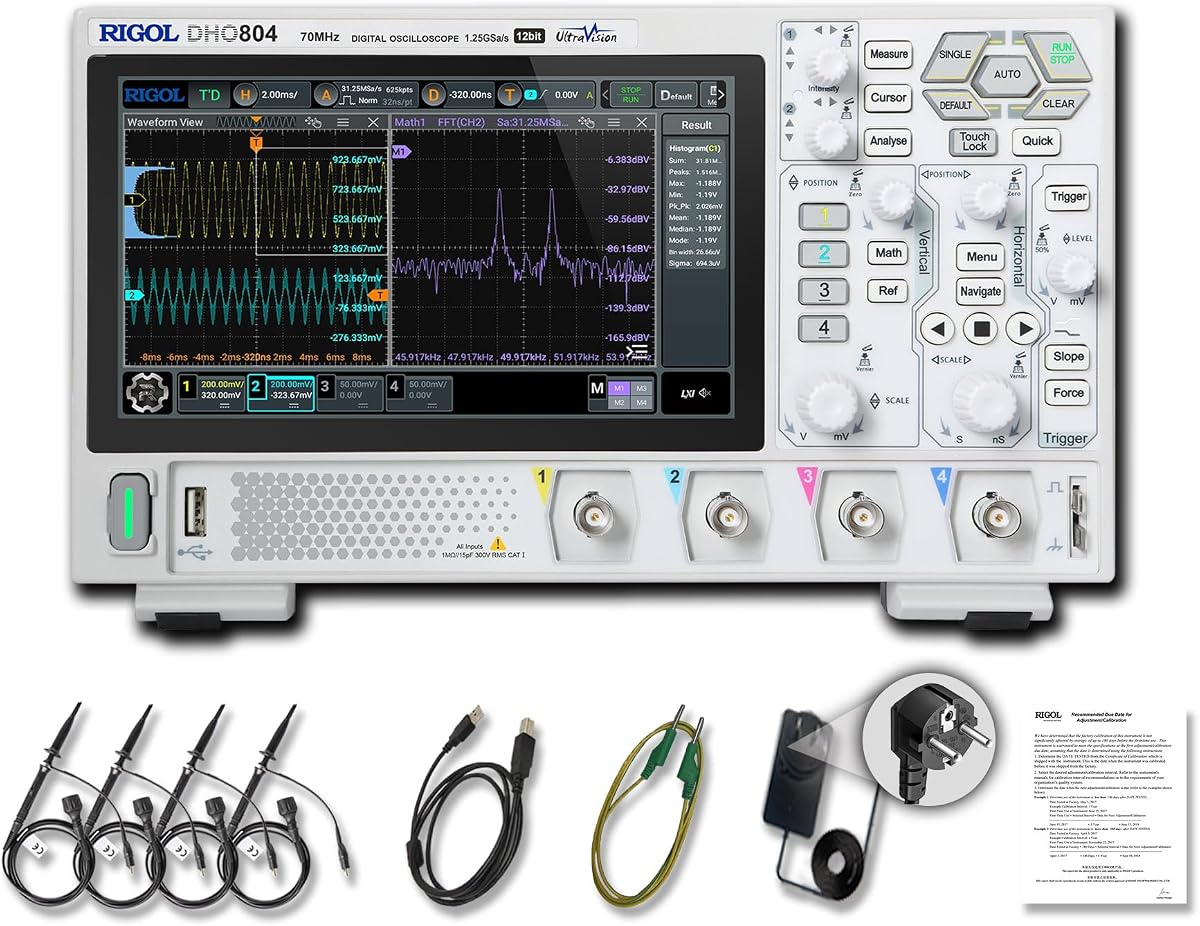
The RIGOL DHO804 stands out as a versatile tool for modern electronics work. With a 4.3 rating, it offers a balance of precision and portability that appeals to engineers and educators alike.
We may earn a commission when you buy through this link, at no additional cost to you.
Its 12-bit resolution provides exceptional vertical detail, allowing users to see small signal variations that standard 8-bit scopes miss. The UltraAcquire technology captures glitches at high speeds, making intermittent issues easier to diagnose.
While it lacks higher bandwidth options found in premium models, its 70MHz limit is sufficient for many embedded and power supply tasks. The lack of a built-in signal generator might require an external tool for some users.
This oscilloscope is ideal for those needing reliable performance without breaking the budget. It is recommended for lab environments where clear visualization and connectivity options are prioritized.
The 12-bit resolution allows for finer voltage measurements, crucial for analyzing noise on power rails.
LAN and USB ports enable easy data export and remote control for automated testing setups.
We may earn a commission when you buy through this link, at no additional cost to you.
The RIGOL DHO924S represents the high end of the lineup with advanced capabilities. Its 4.5 rating reflects strong performance in capturing fast edges and complex signals.
We may earn a commission when you buy through this link, at no additional cost to you.
With 250MHz bandwidth and 50 Mpts memory depth, this scope handles long records and high-speed debugging efficiently. The built-in signal generator adds significant value for testing frequency responses and loop stability.
The main trade-off is the price point, which is higher than entry-level models. Additionally, digital channel probing requires separate accessories not included in the standard package.
Professionals needing rigorous validation tools will find this model worth the investment. It is best suited for advanced lab work where speed and integrated features are critical.
The S model includes a single-channel AFG output allowing direct testing without external hardware.
Up to 50 Mpts memory ensures long acquisitions remain detailed even at high sample rates.
We may earn a commission when you buy through this link, at no additional cost to you.
The FNIRSI DPOS350P is a multi-functional device combining an oscilloscope with spectrum analysis. Rated 4.1, it appeals to users needing portable high bandwidth capabilities in the field.
We may earn a commission when you buy through this link, at no additional cost to you.
It offers 350MHz bandwidth with real-time FFT analysis, making it useful for EMI checks and signal integrity tasks. The built-in DDS signal generator supports custom waveform creation without extra tools.
Battery life and interface complexity can be challenging during extended use. Users may need to spend time learning the advanced features to maximize the device potential.
This unit is perfect for field technicians requiring detailed analysis in compact form. It suits those who need spectrum tools alongside standard waveform viewing.
Real-time waterfall views help identify interference patterns quickly in noisy environments.
Bode plot capabilities allow direct loop stability tests for control systems.
We may earn a commission when you buy through this link, at no additional cost to you.
The RIGOL DS1102Z-E enjoys a high 4.9 rating for its robust performance in educational settings. It provides essential features needed for learning electronics fundamentals effectively.
We may earn a commission when you buy through this link, at no additional cost to you.
With a 30,000 waveform per second capture rate, it reveals glitches that slower scopes might miss. The deep memory allows for long captures without sacrificing sample rate, useful for debugging intermittent issues.
Its interface lacks modern touch controls, which might slow down operation compared to newer models. However, the physical buttons remain reliable for precise adjustments.
This is a top choice for schools and hobbyists seeking durability and value. It delivers professional-grade features at a price point accessible to learners.
The fast update rate ensures you rarely miss intermittent events during testing sessions.
Decoding protocols like I2C and SPI simplifies embedded system troubleshooting.
We may earn a commission when you buy through this link, at no additional cost to you.
The FNIRSI 2C53T combines an oscilloscope with a digital multimeter for added utility. Its 4.3 rating indicates satisfaction with its compact dual functionality for small repairs.
We may earn a commission when you buy through this link, at no additional cost to you.
Users appreciate the ability to measure voltage and view waveforms in one device. The 50MHz bandwidth is adequate for low frequency circuits and hobbyist projects.
The small screen size can limit visibility in bright environments. Additionally, the bandwidth might be insufficient for high speed digital signal analysis.
This model is ideal for maintenance work where carrying multiple tools is inconvenient. It suits hobbyists needing basic diagnostics in a handheld package.
Built-in AC/DC voltage and current measurement eliminates the need for a separate meter.
DDS generator allows for custom waveform outputs useful for testing analog filters.
We may earn a commission when you buy through this link, at no additional cost to you.
The FNIRSI DSO152 is a popular choice for beginners due to its low cost and small size. With a 4.4 rating, it proves surprisingly capable for basic troubleshooting tasks.
We may earn a commission when you buy through this link, at no additional cost to you.
It features a real-time sampling rate of 2.5 MS/s and a 200 kHz bandwidth, sufficient for audio and low frequency digital signals. The pocket-sized form factor makes it easy to carry to remote sites.
Its limitations include a restricted frequency range and basic resolution which may not satisfy advanced users. However, for introductory purposes, it remains a strong entry point.
This device is perfect for students or hobbyists learning circuit basics. It offers an easy way to visualize signals without a significant financial commitment.
The lightweight design allows for easy transport in tool bags or pockets.
Auto settings simplify measurements so users can get started quickly.
We may earn a commission when you buy through this link, at no additional cost to you.
The Hantek DSO2D15 offers a balanced mix of features at an accessible price point. Its 4.6 rating suggests reliability for standard laboratory and educational applications.
We may earn a commission when you buy through this link, at no additional cost to you.
With 150MHz bandwidth and 14 trigger modes, it handles diverse signal analysis needs effectively. The inclusion of serial protocol decodes helps engineers quickly identify communication issues in embedded systems.
The screen resolution and setup process can be less intuitive than competitors. Users may need to consult manuals frequently to maximize the unit's capabilities.
This model is recommended for institutions or workshops needing multiple units without high costs. It serves well for general purpose testing and learning environments.
Built-in support for standard protocols like CAN and UART aids in rapid debugging.
Multiple trigger options allow capturing rare events that might otherwise be missed.
We may earn a commission when you buy through this link, at no additional cost to you.
The FNIRSI 1013D Plus features a modern touchscreen interface that simplifies navigation. With a 4.4 rating, it appeals to users preferring tactile control over physical knobs.
We may earn a commission when you buy through this link, at no additional cost to you.
Its 7-inch display offers high contrast and brightness, making waveforms easy to read. The waveform image manager allows storing thousands of captures for later review.
Touch accuracy can occasionally be less precise than dedicated buttons for small adjustments. The bandwidth remains standard for entry-level work but limits high frequency analysis.
This unit is suitable for general electronics repair and hobbyist projects. It combines modern convenience with reliable performance for everyday use.
Organizing saved data makes it easy to reference previous tests during debugging.
Comparing phase and amplitude visually simplifies signal analysis tasks.
We may earn a commission when you buy through this link, at no additional cost to you.
The Generic Option A listing requires careful verification before purchase. Since details are not fully available, users must confirm specifications match their requirements.
We may earn a commission when you buy through this link, at no additional cost to you.
Lack of detailed product information can lead to unexpected features or limitations. Always check the full description and seller ratings for reassurance.
The main drawback is the uncertainty surrounding performance metrics. It is risky to rely on this model without concrete data.
This option should only be considered if verified by the seller. It is not recommended unless specific needs are clearly met by the confirmed data.
Ensure all technical specs match your needs before finalizing your order.
Reach out to the seller directly to clarify any missing details.
We may earn a commission when you buy through this link, at no additional cost to you.
The Generic Option B listing similarly requires detailed review before any purchase decision. Data availability is limited, making independent verification essential.
We may earn a commission when you buy through this link, at no additional cost to you.
Relying on incomplete listings can result in receiving equipment that does not meet performance standards. Confirming details with the vendor helps avoid misunderstandings.
The primary disadvantage is the uncertainty in performance capabilities. It may not be suitable for critical applications without confirmed details.
This option is best avoided unless specific verification is possible. Proceed with caution and ensure you have all necessary information.
Cross-reference product claims with independent reviews or manufacturer data.
Verify warranty terms to ensure protection in case of defects.
We may earn a commission when you buy through this link, at no additional cost to you.
Choosing the right digital oscilloscope requires evaluating several technical factors to ensure it meets your specific measurement needs and budget constraints.
Bandwidth determines the highest frequency the scope can accurately measure. For most general electronics work, 100MHz is often sufficient, but RF or high-speed digital signals may require 250MHz or higher.
Always choose a bandwidth at least five times higher than the highest frequency signal you expect to analyze for accurate results.
Sampling rate defines how many samples per second the scope takes. Higher rates provide better detail of fast signal edges and ensure you capture rapid transitions.
Look for a sample rate at least 4 to 5 times your bandwidth to avoid aliasing and ensure precise waveform representation.
The number of analog channels allows you to view multiple signals simultaneously. Dual channel scopes are standard, but four channel models provide flexibility for complex debugging.
Consider your typical workflow to determine if two channels are enough or if you need four for comparative analysis.
Memory depth dictates how long the scope can capture data at maximum sample rates. Deep memory helps preserve details over longer time windows without dropping sample points.
Select a model with ample memory if you need to analyze long signals or slow trends alongside fast events.
Modern oscilloscopes offer USB, LAN, or Wi-Fi for data transfer and remote control. These features streamline documentation and integration with automated test systems.
Ensure the ports match your workflow needs for exporting waveforms or connecting to external computers.
A clear, high-resolution display is essential for viewing fine details in waveforms. Touchscreens offer intuitive navigation, while physical buttons allow for precise adjustments.
Prioritize a display size and resolution that allows easy viewing of multiple channels simultaneously.
Handheld or compact models are ideal for field work or mobile labs. Consider weight and battery life if you need to operate away from a power source.
Check battery duration to ensure it supports your typical usage periods without frequent recharging.
Features like protocol decoding, FFT analysis, or built-in signal generators add significant value. These tools can replace separate equipment, saving cost and bench space.
Assess whether these extras are necessary for your specific applications before paying the premium.
Begin by connecting the probes to the appropriate channels and grounding them securely. Ensure the probe settings match the input settings on the scope to maintain accurate scaling.
Use the Auto Set function to quickly stabilize a waveform before adjusting time and voltage dividers manually. This helps you understand the signal baseline before diving into detailed measurements.
Store captured waveforms to internal memory or external drives regularly to prevent data loss. Clean the screen and connectors with soft cloths and avoid extreme temperatures to prolong device life.
For general hobbyist or repair work, 50MHz to 100MHz is typically sufficient. Professional or high-speed digital work may require 200MHz or higher to capture fast edges accurately.
Modern handheld models can offer decent accuracy for field diagnostics. While not replacing lab-grade equipment, they are reliable for quick troubleshooting and basic signal viewing.
Only if you regularly need to compare multiple signals simultaneously. For most users, 2 channels are enough, but 4 channels provide flexibility for complex debugging tasks.
12-bit resolution provides more voltage levels than standard 8-bit scopes. This allows seeing smaller voltage variations which is helpful for analyzing noise on power supplies.
Only if the probes are rated for the voltage levels. Always use probes with sufficient safety ratings to avoid damage to the scope or personal injury during high voltage testing.
Use the protocol decoding feature if available on your model. Connect the data and clock lines to appropriate channels and select the protocol type in the decode menu.
Touchscreens offer intuitive navigation but may lack precision for fine tuning. Physical buttons ensure stable settings during adjustments. Many models combine both for the best of both worlds.
Annual calibration is recommended for professional use to maintain accuracy. Hobbyists may check calibration only if measurements seem off or after significant impact to the device.
We have highlighted ten models ranging from portable budget units to advanced bench instruments. Each option serves specific needs, whether you prioritize bandwidth, portability, or integrated features.
Prioritize bandwidth and sampling rate based on your typical signal types to ensure you get clear images. Also consider connectivity and display features that streamline your daily workflow.
Prices and stock levels change frequently, so verify the latest offers on product pages. Selecting the right oscilloscope now will save time and provide reliable data for your future projects.