
1000X Handheld Digital Microscope for Kids
4.5Editor score
1000X Magnification
2.0 Inch IPS Screen
Lightweight Portable Design
Exploring the microscopic world of insects requires the right tool to reveal intricate details hidden from the naked eye. A digital microscope offers a modern solution by capturing images and videos directly to screens, making observation accessible and educational for all ages.
We have evaluated ten leading digital microscopes based on magnification power, connectivity options, image resolution, and ease of use for insect study. Our comparison highlights models suitable for backyard exploration, classroom education, and detailed scientific observation of small specimens.
Each selection in this guide showcases specific strengths such as wireless connectivity, built-in displays, or advanced optical systems. Please note that product availability and pricing may change over time, so verify current details before making your final purchase decision.
4.5Editor score

4.5Editor score

4.3Editor score
As an Amazon Associate we earn from qualifying purchases.
This side-by-side comparison outlines the core specifications and capabilities of each digital microscope to help you choose the right tool for insect observation and study.



The Andonstar AD246S-M stands out as a powerful tool for insect enthusiasts who need high fidelity imaging and recording capabilities. With a rating of 4.5 stars, users appreciate the ability to capture ultra-high definition videos directly to an HDMI screen or monitor for detailed analysis.
We may earn a commission when you buy through this link, at no additional cost to you.
Its three interchangeable lenses allow for flexible observation ranging from macro views of whole insects to microscopic details of biological slides. The included measurement software adds scientific value by enabling precise length and area calculations on captured images.
While the setup requires an external monitor for the best visual experience, this trade-off ensures you see every detail of insect anatomy with clarity. The sturdy metal stand provides the stability needed for high magnification work without vibration blur.
This microscope is ideal for adults and serious students who require professional-grade features for biology study or hobbyist exploration. It offers a comprehensive kit with accessories that support various observation needs out of the box.
The 2160P video recording ensures that even the finest details of insect wings or textures are captured with exceptional clarity for later review.
Swapping between lenses for different tasks like coin inspection or biological slide observation makes this a versatile tool for multiple scientific interests.
We may earn a commission when you buy through this link, at no additional cost to you.
The Skybasic Wireless Digital Microscope offers an accessible entry point for students and casual users interested in studying insects without a bulky setup. Its ability to connect via WiFi to smartphones and tablets makes capturing images of moving specimens easier in the field.
We may earn a commission when you buy through this link, at no additional cost to you.
Users benefit from eight adjustable LED lights that help illuminate dark or shaded areas where insects might be hiding. The included adjustable stand provides a stable platform for hands-free observation when needed during longer sessions.
While the fixed focus nature means it is not suitable for professional biologists, it serves well as a magnifying glass replacement for general exploration. Connection steps require careful attention to device settings to ensure smooth performance across different operating systems.
This device is perfect for families or classrooms looking for a budget-friendly way to introduce digital microscopy concepts. Its compatibility with both mobile and desktop systems offers flexibility in how lessons are conducted.
Connecting directly to iOS or Android devices allows for instant sharing of discoveries with classmates or friends during outdoor activities.
Adjustable LED lights ensure that specimens are properly illuminated regardless of ambient light conditions in indoor or outdoor settings.
We may earn a commission when you buy through this link, at no additional cost to you.
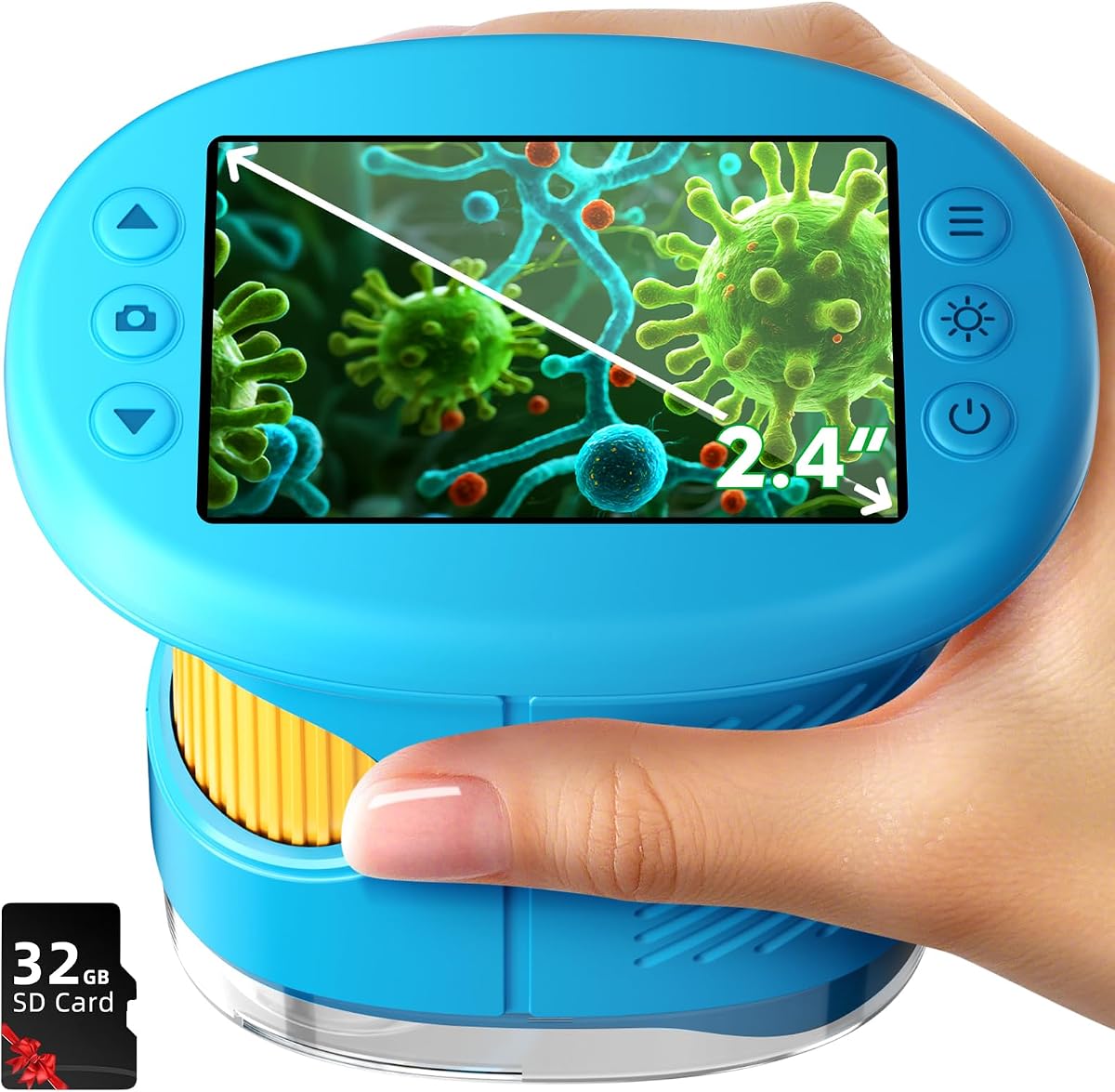
The Odatay 4K Digital Microscope is designed specifically with young children in mind, offering a self-contained viewing experience without needing external devices. Its 2.4-inch screen lets kids see insects and plants instantly wherever they are exploring.
We may earn a commission when you buy through this link, at no additional cost to you.
Included accessories like a 32GB card and twelve prepared slides provide immediate value for educational activities right out of the box. The long-distance viewing capability allows children to observe larger objects without getting too close.
While the screen resolution is good for general use, it may not reveal the finest microscopic details compared to larger monitor setups. The device remains highly rated for its ease of use and durability in the hands of active children.
This kit serves as an ideal gift for sparking curiosity about nature and science in early education. It combines learning with play effectively to encourage independent exploration and observation skills.
The built-in screen eliminates the need to carry extra tablets or laptops, making field trips simpler and more focused on discovery.
Prepared slides and storage cards ensure that children can start documenting their findings immediately without additional purchases.
We may earn a commission when you buy through this link, at no additional cost to you.
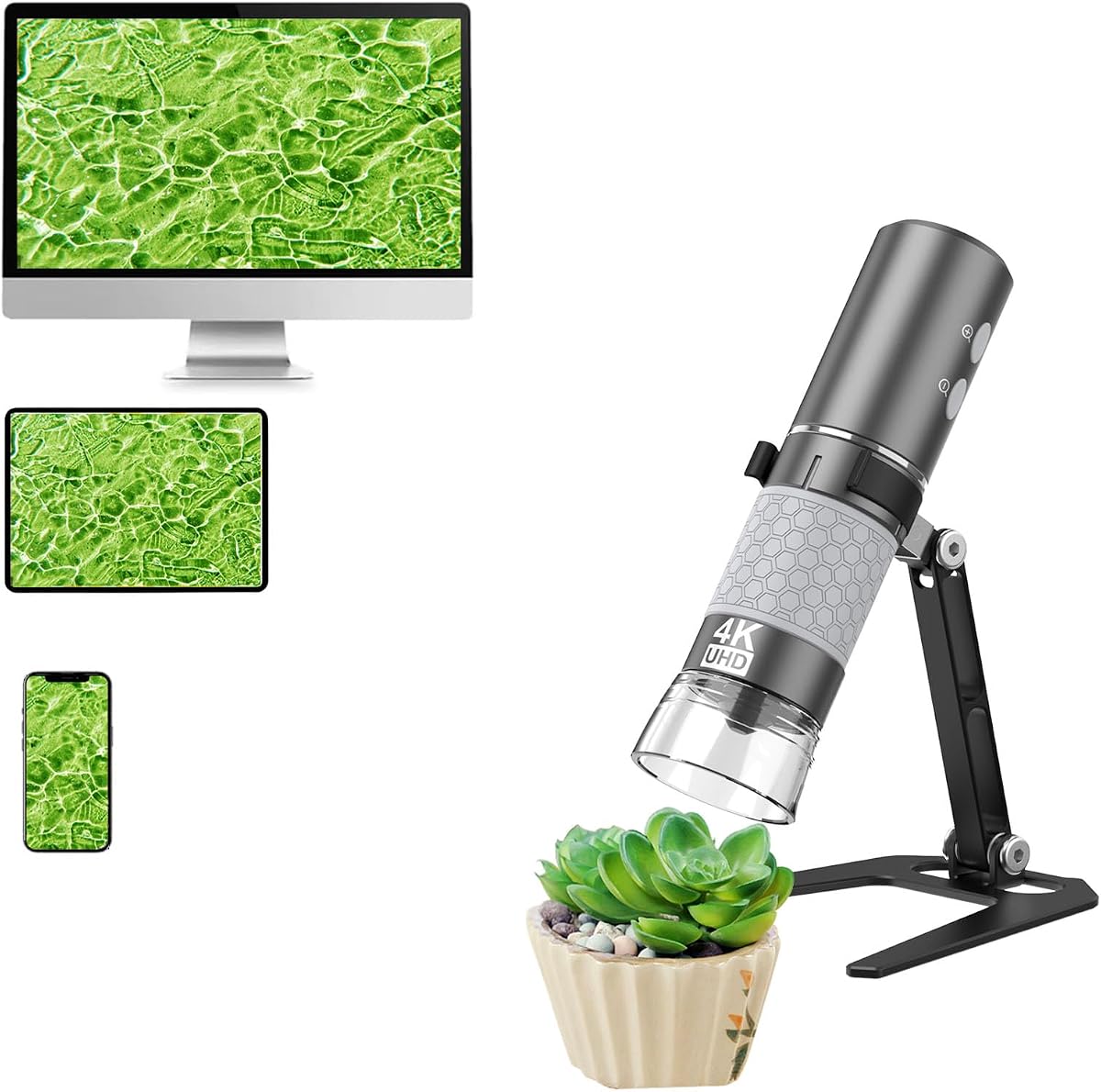
This WiFi Digital Microscope stands out for its extended battery life which supports several hours of continuous observation during outdoor adventures. The 4K resolution capability ensures that images captured are crisp and detailed for later study.
We may earn a commission when you buy through this link, at no additional cost to you.
The adjustable bracket allows users to position the microscope at various angles which is helpful when observing insects on leaves or uneven terrain. Compatibility across iOS, Android, and PC systems makes sharing files and data straightforward for educational projects.
While the app installation and connection process can take time to set up correctly, the performance once connected is reliable for most standard observation tasks. The lightweight design complements the battery capacity to keep carrying load minimal.
It is an excellent choice for travelers or students who need a reliable tool that can work independently of a power source. The versatility of connectivity options adds significant value for diverse use cases.
The four-hour battery life ensures that long field trips do not result in missed opportunities to observe insect behavior in real time.
4K resolution support provides exceptional detail for analyzing textures and patterns on insect bodies when connected to a high resolution display.
We may earn a commission when you buy through this link, at no additional cost to you.
This 1000X Handheld Digital Microscope is a top value option that balances performance with affordability for young students. The inclusion of an IPS screen means children can view their findings immediately without needing a separate device.
We may earn a commission when you buy through this link, at no additional cost to you.
Its anti-shake stabilization helps maintain clear images even when holding the device in a moving environment like a classroom or backyard. This feature is particularly useful for capturing stable video of insects in motion.
The manual focus system provides a more realistic scientific experience compared to fixed focus toys, helping children learn how optics work. However, the battery life is shorter than some competitors so planning around charging is necessary for extended use.
It is highly recommended as an introductory tool for families seeking to teach science without a significant financial investment. The ease of exporting files to computers allows for further analysis and documentation of projects.
Manual focus control teaches children about the mechanics of microscopy and helps develop patience and observation skills during use.
Simple USB export lets users save photos and videos to a computer for creating science reports or sharing with teachers easily.
We may earn a commission when you buy through this link, at no additional cost to you.
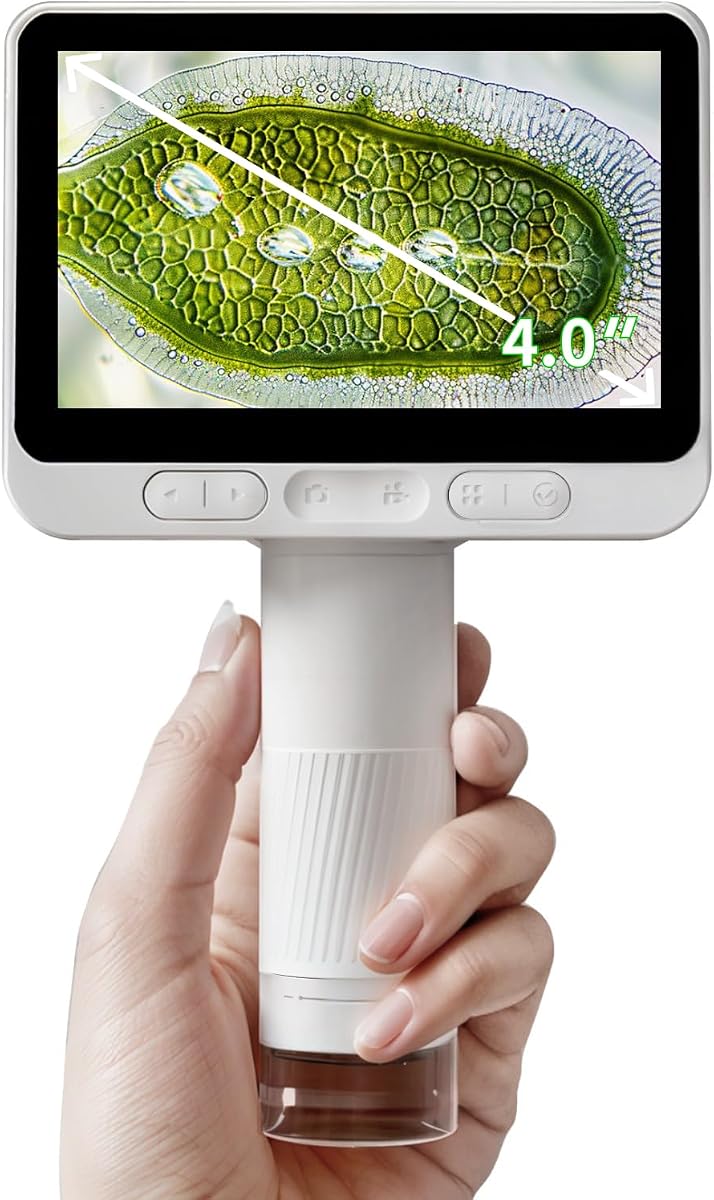
The BEAVERLAB Finder features a notably large 4.0-inch screen which makes sharing observations among groups of children much easier than smaller models. The 1600X magnification provides ample detail for most insect study needs without requiring external lenses.
We may earn a commission when you buy through this link, at no additional cost to you.
Its built-in hotspot allows users to upload images directly to mobile devices which simplifies the sharing process during lessons or field trips. This connectivity option is a significant advantage for collaborative learning environments.
While the device is slightly heavier due to the larger screen, it remains portable enough for everyday use. The 1080P video recording ensures that moving specimens are captured smoothly for later review and analysis.
This microscope is excellent for classroom settings where multiple students need to view the same specimen simultaneously. The combination of screen size and connectivity makes it a practical tool for educational demonstrations.
The large display allows teachers or parents to show specimens to multiple children at once without crowding around a small screen.
Built-in hotspot capability enables direct transfer of images to phones or tablets without cables which speeds up documentation time.
We may earn a commission when you buy through this link, at no additional cost to you.
Built with durability in mind, this digital handheld microscope withstands the bumps and drops common during outdoor insect exploration. Its ABS plastic construction is BPA-free ensuring safety for younger children handling the device daily.
We may earn a commission when you buy through this link, at no additional cost to you.
The 2-inch HD display provides a clear view of specimens while the adjustable LED lights help when exploring in shaded or dim areas. Built-in storage saves photos and videos internally so no extra cards are needed for basic use.
Although the battery life is shorter than some premium options, it is sufficient for typical field trips. The USB-C charging modernizes power management making it easier to find a replacement cable if one is lost.
This microscope is ideal for active children who need a robust tool for nature studies. Its simple design ensures that the focus remains on discovery rather than managing complex settings or accessories.
The shock-absorbent rubber casing protects the internal components from drops, ensuring longevity even with enthusiastic young users.
USB-C support allows for quick charging with widely available cables so the device is ready for use after a short charge time.
We may earn a commission when you buy through this link, at no additional cost to you.
The Elikliv Autofocus microscope utilizes AI algorithms and a TOF sensor to automatically adjust focus which is rare in this category. This capability makes observing moving insects significantly easier as the system maintains clarity without manual intervention.
We may earn a commission when you buy through this link, at no additional cost to you.
Its large 8-inch IPS screen provides a vivid and bright view of specimens that can be seen by multiple people in a room. The 4K resolution ensures that every detail from wing veins to leg textures is rendered with high fidelity.
While the device is bulkier than handheld units, the trade-off offers a professional viewing experience suitable for detailed analysis or teaching. The smart controller allows for easy photo capture and zoom adjustments without reaching for the unit.
This model is best for advanced hobbyists or educators who need reliable performance for dynamic specimens. The split screen feature aids in comparing different views or specimens side by side for educational purposes.
The sensor technology continuously refocuses the image which is critical when studying active insects that move constantly in the frame.
The 8-inch screen provides ample viewing real estate allowing for detailed examination without eye strain during long observation sessions.
We may earn a commission when you buy through this link, at no additional cost to you.
This 4K WiFi Microscope stands out for its broad compatibility spanning iOS, Android, Windows, Mac, Linux, and Chrome OS. It ensures that schools or offices with mixed device environments can use the same microscope without software issues.
We may earn a commission when you buy through this link, at no additional cost to you.
The wide angle lens is particularly useful for capturing whole objects like leaves or larger insects in a single frame. A long focal length allows users to keep distance from sensitive specimens or heat sources during observation.
While zoom controls do not work on PC systems for some versions, basic viewing remains functional across all platforms. The 4K resolution support delivers high fidelity images when connected to compatible devices.
It is an excellent choice for diverse technical environments where device standardization is not possible. The flexibility ensures that users can observe and share findings regardless of the hardware they use for work or study.
Support for Linux and Chrome OS expands accessibility for schools using alternative operating systems beyond standard Windows or Mac setups.
The wide angle and long focal length features provide versatility for both detailed close-ups and broader environmental observations of insects.
We may earn a commission when you buy through this link, at no additional cost to you.
The Andonstar AD266S offers the highest magnification range reaching up to 5000X with the use of specific lenses. This level of detail is perfect for advanced biological studies requiring deep analysis of insect cell structures or microscopic features.
We may earn a commission when you buy through this link, at no additional cost to you.
Its X-Y moveable stage allows for precise movement of specimens which is essential when scanning slides for specific areas. The five interchangeable lenses provide a wide range of viewing capabilities from macro to ultra micro observation.
While the setup is more complex than handheld models, it offers a laboratory experience at home or in a small classroom. The 2160P HDMI video capability ensures that high quality visuals are available for documentation and reporting.
This model is best suited for serious students and educators who need professional grade tools for advanced biology work. The investment in a mechanical stage and high magnification opens up possibilities for rigorous scientific inquiry.
The X-Y moveable stage enables users to navigate slides systematically which is vital for thorough examinations of biological samples.
With up to 5000X power, users can explore cellular details that are otherwise invisible to standard digital microscopes in consumer markets.
We may earn a commission when you buy through this link, at no additional cost to you.
Selecting the right digital microscope depends on several technical and practical factors. This guide explains the key elements to consider for effective insect study.
Magnification determines how much detail you can see on an insect. For general observation, 1000X is sufficient to view wing veins and body segments. Higher ranges up to 5000X are necessary for cellular level study but require stable setups.
Choose a range that matches your intended study depth whether casual exploration or detailed biological analysis.
Resolution defines the clarity of the captured images and videos. 1080P offers good detail for general use while 4K provides sharper images for professional reporting. Ensure your viewing device supports the resolution output for best results.
Higher resolution is beneficial for documenting small features but may require more storage space for files.
Digital microscopes connect via WiFi USB or HDMI. WiFi allows wireless viewing on phones which is great for portability. HDMI connects to larger screens for group viewing. USB offers reliable data transfer to computers for analysis.
Select connectivity based on how you plan to view and share your findings during observation sessions.
Handheld models are lightweight and battery powered for field use. Stationary models with stands are heavier but offer stability for high magnification. Battery life varies from 2 to 4 hours affecting field trip duration.
Prioritize portability if you explore outdoors often or stability if you study at a desk mostly.
Some models have built-in screens for instant viewing while others require a computer or monitor. Built-in screens add to the device weight but remove the need for extra hardware. External screens provide larger views for groups.
Consider if you want a self-contained unit or a flexible setup using existing devices.
Handheld microscopes often include anti shake features to keep images steady during movement. Stable stands are critical for high magnification to prevent vibration blur. Look for designs that support steady viewing during observation.
Stabilization ensures clear images especially when studying moving insects or shaky hands.
Internal memory or SD card slots allow saving photos and videos. USB export capabilities are needed to transfer files to computers. Check if the model includes necessary cables or software for data management.
Robust storage features help in organizing and reviewing scientific findings over time effectively.
Adjustable LED lights are essential for illuminating specimens clearly. Different brightness levels help adapt to various environments from dark corners to bright sunlight. Good lighting improves image quality significantly.
Look for multiple LEDs or adjustable intensity to ensure consistent visibility during use.
To begin using your digital microscope, ensure the battery is fully charged and the device is powered on. Connect it to your smartphone computer or monitor using the recommended method such as WiFi or USB. Adjust the focus wheel gently until the image becomes sharp.
When observing insects, place the specimen under the lens and use the adjustable LED lights to illuminate it properly. Avoid touching the lens with fingers to prevent smudges. Use the capture button to save photos or videos of interesting details.
After use, store the device in a protective case to prevent damage. Clean the lens with a soft cloth regularly. Charge the battery as needed to maintain performance and update the app or software if available for the best experience.
Yes many digital microscopes are designed for live specimen observation. Ensure you provide adequate lighting and ventilation if keeping the insect in a container. Use lower magnification to avoid disturbing the insect too much.
For most insect anatomy study, a range between 200X and 1000X is ideal. This allows you to see details like wing veins and leg joints without needing complex optical setups. Higher magnification may blur images if lighting is not perfect.
Transfer images by connecting the microscope to your computer via USB or using WiFi to download files to your mobile device then share to PC. Ensure the necessary drivers or software are installed for recognition by your operating system.
Many digital microscopes are designed with children in mind featuring simple controls and built-in screens. Look for models with safety certifications and durable designs. Parental guidance during initial setup ensures a smooth learning experience.
A stand is highly recommended for stable viewing especially at higher magnification. While handheld use is possible for quick checks, a stand reduces shake and allows for longer observation sessions without fatigue.
Clean the lens using a soft lint free cloth specifically designed for optics. Avoid using harsh chemicals that could damage coatings. If smudges persist, use a lens cleaning solution sparingly applied to the cloth not directly to the lens.
Typical accessories include USB cables, stands, and sometimes SD cards. Higher end models may include prepared slides or extra lenses. Check the package content before purchasing to ensure you have everything needed to start.
Most digital microscopes have built-in LED lights to assist in low light conditions. These lights provide sufficient illumination for indoor use or dark outdoor environments. Ensure the brightness settings are adjusted for the best image contrast.
This guide highlights a range of digital microscopes from budget friendly handheld options to high end laboratory grade tools. Models like the Andonstar AD246S-M offer professional features while others like the Odatay 4K suit younger learners.
Consider your primary use case whether casual exploration or detailed scientific analysis when making a decision. Portability and connectivity features are often just as important as magnification for practical fieldwork.
Prices and availability may change so review current product details and user feedback before purchasing. The right microscope will enhance your understanding of insect life and inspire further exploration of the natural world.