
2Pcs ADS1115 16 Bit I2C Module
5.0Editor score
High accuracy conversion
Wide voltage supply range
Compatible with Raspberry Pi
This guide compares the top Arduino ADC boards for precision data acquisition, covering resolution, channel count, and interface options for makers and
Arduino projects often require reading analog signals with higher precision than the built-in ADC offers. External ADC boards bridge this gap, enabling accurate sensor measurements for professional and hobbyist applications alike.
We evaluated ten leading ADC modules based on resolution, channel flexibility, communication protocols, and community support. Each product was selected for its reliability and ease of integration into existing Arduino ecosystems.
Every pick highlights key strengths and ideal use cases to help you choose the right tool. Note that pricing and availability fluctuate, so verify current listings before purchasing your components.
5.0Editor score

4.7Editor score

4.6Editor score
The following table provides a side-by-side comparison of all ten selected Arduino ADC boards to help you quickly identify the best fit for your specific project requirements and technical constraints.


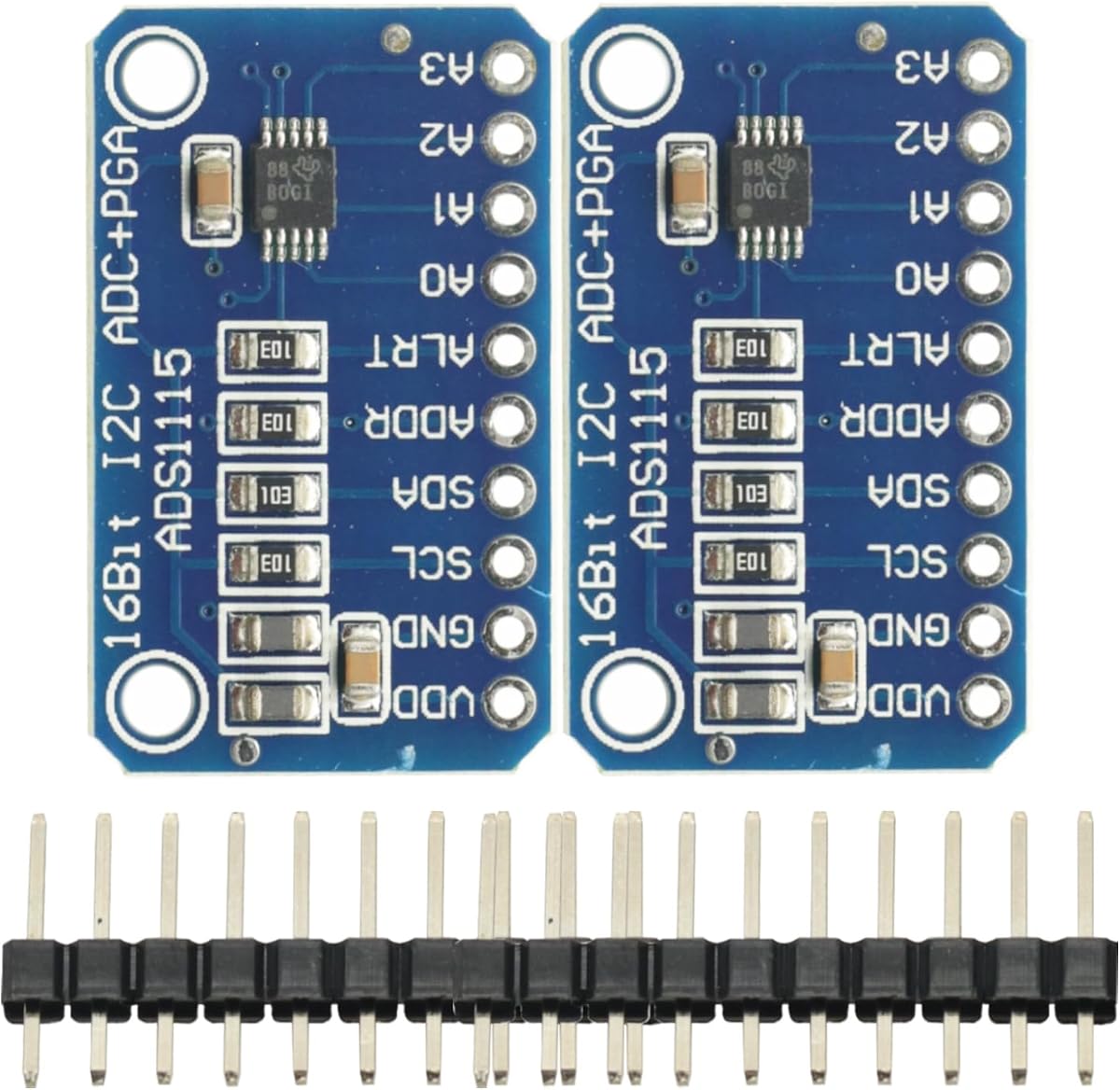


This Teyleten Robot module delivers reliable 16-bit ADC performance for precise signal acquisition. It features a robust design with programmable gain amplification to suit various sensor types and input ranges.
We may earn a commission when you buy through this link, at no additional cost to you.
The four-channel input flexibility allows simultaneous monitoring of multiple sensors. Its I2C interface simplifies wiring with Arduino boards, reducing pin usage while maintaining clear data paths for complex projects.
While the data rate peaks at 860 samples per second, it remains ideal for steady-state monitoring. The included pack ensures you have spares for prototyping or multi-node distributed sensor systems.
Buyers seeking accuracy for environmental monitoring or battery voltage checks will find this board excellent. It balances cost and performance effectively, making it a top choice for most general-purpose ADC needs.
The onboard PGA allows users to adjust input ranges dynamically for maximum resolution. This feature enhances sensitivity when measuring small voltage changes in low-level signals.
Support for both single-ended and differential inputs expands usage scenarios. Users can connect two differential pairs or four single-ended sensors depending on project needs.
We may earn a commission when you buy through this link, at no additional cost to you.
The HiLetgo ADS1256 offers exceptional 24-bit resolution for demanding industrial applications. It captures minute voltage fluctuations that lower resolution boards might miss, ensuring data integrity in critical experiments.
We may earn a commission when you buy through this link, at no additional cost to you.
Its eight-channel capacity makes it powerful for multi-point acquisition tasks. Whether measuring temperature gradients or mechanical stress across multiple points, this board consolidates data gathering efficiently into one module.
Users should note the SPI interface requires more pins and precise timing setup. The module operates at 5V and consumes more power than simpler I2C options, so plan your power budget accordingly.
For lab-grade accuracy or high-fidelity sensor data logging, this unit is unmatched in this price range. It is best suited for experienced users who need maximum resolution and channel count.
The 24-bit capability provides deep precision for scientific and industrial measurements. Users can detect microvolt-level changes effectively with this high-fidelity conversion technology.
An integrated 2.5V reference voltage ensures consistent baseline measurements. This feature reduces external component needs and enhances measurement accuracy over time.
We may earn a commission when you buy through this link, at no additional cost to you.
This budget-friendly option provides two ADS1115 modules, making it ideal for prototyping. It delivers solid 16-bit conversion at a fraction of the cost of more complex multi-channel units.
We may earn a commission when you buy through this link, at no additional cost to you.
The straightforward I2C interface reduces wiring complexity significantly. Users can quickly connect multiple sensors and read data without advanced configuration, speeding up development cycles for new projects.
While it lacks some advanced features like high-speed sampling, it covers most hobbyist needs effectively. The consistent high ratings reflect reliable performance and ease of use for first-time buyers.
Anyone needing a simple ADC solution for light-duty tasks will appreciate this value. It is perfect for classroom labs or personal DIY electronics where cost and simplicity are top priorities.
This module prioritizes essential ADC functions without unnecessary bloat. Users gain reliable 16-bit precision at a very accessible price point for any project.
The inclusion of two boards allows for immediate testing across different setups. Builders can deploy one in production and keep another for spare parts or development.
We may earn a commission when you buy through this link, at no additional cost to you.
This kit includes three identical ADS1115 modules for extensive multi-sensor deployments. Each board offers standard 16-bit resolution with a programmable gain amplifier to handle varied input levels reliably.
We may earn a commission when you buy through this link, at no additional cost to you.
The inclusion of a comparator mode allows for threshold monitoring without continuous data polling. This feature is particularly useful for alarm systems where immediate triggers are necessary for safety alerts.
Users will find the wiring and setup process straightforward across all three units. The consistent supply range ensures they can be powered by standard 5V or 3.3V logic sources without issues.
Buyers looking to equip a workshop or teach multiple students simultaneously will find this pack valuable. The quantity allows for simultaneous testing and reduces downtime when components are needed quickly.
The built-in comparator allows threshold monitoring without constant polling. This feature saves processing power and enables immediate triggers for safety alarms.
Getting three units simplifies sourcing for group projects or workshops. It reduces the administrative burden of ordering multiple individual packs separately.
We may earn a commission when you buy through this link, at no additional cost to you.
This bulk pack provides four ADC modules, making it suitable for large-scale data logging projects. Each module supports multiple channels and features an internal oscillator to ensure timing stability without external components.
We may earn a commission when you buy through this link, at no additional cost to you.
The ability to chain these modules via I2C allows for scalable sensor networks. Users can expand monitoring points significantly while maintaining a consistent interface protocol across the entire system.
Prospective buyers should consider the wiring requirements for multiple modules on a single bus. Addressing pins may need configuration to avoid conflicts, which requires some planning during assembly.
For industrial prototypes or environmental monitoring spanning wide areas, this quantity of modules is highly beneficial. It minimizes the need for reordering and supports rapid deployment of sensor nodes.
An internal oscillator ensures stable timing without needing external crystals. This simplifies the board design and reduces overall component count for users.
Chaining multiple modules allows for expansive sensor coverage easily. Users can monitor distinct locations efficiently while maintaining centralized control.
We may earn a commission when you buy through this link, at no additional cost to you.
This dual-pack offers a reliable starting point for ADC integration in various projects. It includes two high-precision modules with programmable gain to adapt to different signal amplitudes effectively.
We may earn a commission when you buy through this link, at no additional cost to you.
The broad voltage supply range allows operation across different system voltages without level shifters. This flexibility simplifies power management when interfacing with both 3.3V and 5V logic boards.
Users can configure inputs as single-ended or differential pairs depending on noise sensitivity needs. This versatility ensures the modules remain useful even in electrically noisy environments.
For hobbyists needing basic data acquisition for weather stations or battery monitoring, these units are ideal. They provide consistent performance and high customer satisfaction for entry-level technical applications.
Configurable inputs support both single-ended and differential signaling. This versatility improves noise rejection and measurement flexibility for various sensor types.
Wide voltage compatibility reduces the need for additional power regulation. This feature streamlines circuit design and enhances reliability across different systems.
We may earn a commission when you buy through this link, at no additional cost to you.
This 3-pack emphasizes build quality with electroless nickel immersion gold plating. The finish ensures long-term reliability and ease of soldering, which is valuable for projects requiring durable connections.
We may earn a commission when you buy through this link, at no additional cost to you.
Users benefit from excellent tolerance to both 3.3V and 5V logic levels without extra components. This compatibility makes it straightforward to connect with modern microcontrollers like ESP32 or Raspberry Pi directly.
The boards come with pre-soldered headers ready for immediate breadboard use. This convenience speeds up prototyping and eliminates the need for manual soldering in early development stages.
Engineers and educators preferring high-quality components will appreciate this premium offering. The robust construction minimizes failure risks, making it suitable for long-term testing and demonstration.
Gold plating provides strong oxidation resistance for long-term reliability. This ensures consistent electrical performance even in harsh storage conditions.
Pre-soldered headers eliminate manual assembly steps. Users can start prototyping immediately upon receiving the boards for faster development cycles.
We may earn a commission when you buy through this link, at no additional cost to you.
This module is designed for industrial applications requiring fast, synchronized data acquisition across multiple channels. It supports input ranges up to ±10V, making it robust for high-voltage signal conditioning tasks.
We may earn a commission when you buy through this link, at no additional cost to you.
The 200KHz sampling rate is significantly faster than standard ADC boards. This capability allows for capturing transient signals or fast-changing waveforms that other modules would miss entirely.
However, the parallel data output and strict timing requirements demand careful hardware design. It is best suited for experienced users familiar with SPI protocols and complex interface wiring challenges.
For high-frequency monitoring or industrial control systems, this unit offers unmatched speed. Users should verify their microcontroller can handle the data throughput before integration.
The ±10V input range allows direct measurement of larger industrial signals. This capability eliminates external attenuators for many high-voltage applications.
Simultaneous sampling ensures phase-accurate multi-channel data. This feature is critical for accurate motor control or waveform analysis tasks.
We may earn a commission when you buy through this link, at no additional cost to you.
This bulk pack delivers four high-precision ADC modules for large-scale sensing projects. It offers stable readings and easy integration with microcontrollers, making it ideal for classroom or workshop use.
We may earn a commission when you buy through this link, at no additional cost to you.
Users appreciate the straightforward I2C interface which minimizes wiring complexity. This simplifies the physical setup when connecting multiple sensors to a single development board.
While not designed for high-speed data, it handles steady sensor monitoring efficiently. It is well-suited for environmental tracking or simple automation control tasks.
Buyers needing multiple units for distributed systems will find this value pack practical. It ensures enough components are on hand for extensive deployments without additional sourcing delays.
Having four units simplifies large project deployments immediately. This saves time and logistics compared to ordering individual modules one by one.
The standard interface requires minimal setup for immediate operation. This reduces the learning curve for beginners working with analog inputs.
We may earn a commission when you buy through this link, at no additional cost to you.
This HiLetgo model offers reliable 16-bit resolution for a wide range of applications. It features a programmable gain amplifier that adapts to various sensor signal strengths without extra circuitry.
We may earn a commission when you buy through this link, at no additional cost to you.
The straightforward I2C communication makes it easy to connect to Arduino or Raspberry Pi directly. Users can start reading analog values quickly without complex hardware configurations or logic levels.
While it operates at moderate speeds, it excels in low-frequency monitoring tasks. Its consistent performance ensures steady data output for long-term logging or control loop applications.
For general DIY projects or educational labs, this board provides the necessary precision and simplicity. It is a dependable choice for users needing accurate analog conversion without advanced features.
The programmable gain amplifier allows flexible sensor matching. Users can optimize resolution for both low and high-level signals effectively.
Standard I2C interfaces work with common microcontroller voltages. This simplifies integration into existing electronics or development boards.
We may earn a commission when you buy through this link, at no additional cost to you.
Selecting the right ADC board involves balancing resolution, channel count, and interface needs. Understanding these factors ensures your sensor data meets project accuracy requirements.
Resolution determines how finely the ADC can distinguish between voltage levels. Higher bit depths like 24-bit capture subtle changes better than 12-bit or 16-bit options.
For general hobby projects, 16-bit offers sufficient precision. Industrial applications requiring microvolt accuracy may need 24-bit modules for reliable signal integrity.
Consider how many simultaneous sensor inputs your project needs. Some boards support four channels while others offer up to eight for complex monitoring setups.
Differential input capability is crucial for noisy environments. It reduces interference by measuring voltage differences rather than absolute ground-referenced levels.
I2C is convenient for saving pins and supports multiple devices on one bus. SPI is faster but requires more wiring and clock synchronization logic for operation.
Choose I2C for simplicity or SPI if your project involves high data throughput. Ensure your microcontroller supports the selected protocol natively.
Sampling rate defines how many readings the ADC can take per second. Higher rates are vital for capturing fast-changing signals or audio waveforms accurately.
Standard environmental sensors rarely need high speeds. Most temperature or voltage monitors work well with rates under 1,000 samples per second.
A built-in PGA allows adjustment of input ranges to maximize resolution. This is essential when measuring small signals alongside larger voltage levels.
Ensure the gain range matches your specific sensor requirements. Proper configuration significantly improves accuracy for low-level analog sources.
Verify the ADC's voltage range matches your system. Some modules work with 3.3V while others require 5V or wider tolerance ranges.
Logic level tolerance prevents damage to your microcontroller. Choose boards that support your target platform's logic levels directly without extra shifters.
Quality soldering and materials affect long-term reliability. Look for modules with stable components and corrosion-resistant finishes for industrial use.
Durability ensures consistent performance over time. Poor quality boards may introduce noise or drift, compromising your data integrity.
Robust libraries and clear documentation speed up development. Open-source communities provide troubleshooting tips and code examples for popular modules.
Choose products with active support networks. This ensures you can find help quickly when facing integration or configuration challenges.
Start by connecting power and ground pins correctly. Most modules require stable voltage to avoid noise during conversion. Always double-check polarity before applying power to prevent damage.
Wire data lines using short cables to minimize interference. Keep signal paths away from noisy components like motors or high-frequency transmitters. Proper grounding ensures accurate readings and prevents signal degradation.
Store unused boards in anti-static bags to protect sensitive components. Avoid exposing modules to extreme humidity or temperatures. Regularly clean contact pins to maintain reliable electrical connections over time.
The ADS1115 offers 16-bit resolution and I2C interface, suitable for general-purpose low-speed tasks. In contrast, the ADS1256 provides 24-bit resolution and SPI interface, making it ideal for industrial precision and higher throughput requirements.
Yes, many ADC modules like ADS1115 support I2C addressing. By setting unique addresses on the ADDR pin, you can connect up to four units to one bus for a total of 16 channels.
Most I2C or SPI ADC boards are compatible with Raspberry Pi. GPIO libraries such as smbus or spidev allow direct communication. Always ensure voltage levels match the Pi's GPIO standards.
Use differential input mode and short signal wires to minimize interference. Adding a capacitor across VCC and GND can smooth power supply ripple. Proper shielding and grounding further enhance signal clarity.
A PGA allows you to adjust the input voltage range dynamically. This feature amplifies small signals to utilize the full resolution range, improving accuracy for low-voltage sensors.
Higher sampling rates capture fast signal changes without aliasing. For slow-changing data like temperature, low rates suffice. Audio or vibration analysis requires higher rates to preserve signal fidelity.
This guide covered ten exceptional ADC boards ranging from entry-level to industrial-grade performance. Whether you prioritize cost, precision, or channel count, there is a suitable option for every project scale.
Prioritize resolution and interface compatibility based on your specific sensor needs. A well-matched module ensures reliable data acquisition and smoother development cycles.
Remember to verify current pricing and stock before purchasing. Tech components evolve rapidly, and staying updated ensures you get the best value and latest features.